Strong and weak acids and bases
Strong versus weak
Strong and weak describe how completely a substance ionises in water — not how concentrated it is.
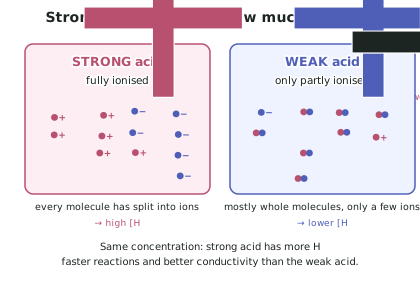
- A strong acid ionises completely in water: essentially every molecule donates its proton.
- A weak acid ionises only partially: most molecules stay intact, and an equilibrium is set up.
Writing the equations
The arrow is the giveaway, and using the wrong one is a common lost mark:
-
Strong acid — single arrow, because the reaction goes to completion:
-
Weak acid — equilibrium arrow, because most molecules remain un-ionised:
-
Strong bases behave the same way: , complete.
-
Weak bases set up an equilibrium: .
The ones to know
| Strong | Weak | |
|---|---|---|
| Acids | HCl, , | (ethanoic), other carboxylic acids |
| Bases | NaOH, KOH | , amines |
Concentration is a different idea
This distinction is worth stating explicitly, because it is the most-tested misconception in the topic:
-
Strong / weak — how completely the acid ionises. A property of the substance.
-
Concentrated / dilute — how much acid there is per litre. A property of the solution.
-
The four combinations all exist: you can have dilute hydrochloric acid (strong but dilute) and concentrated ethanoic acid (weak but concentrated).
-
So the correct opposites are strong ↔ weak and concentrated ↔ dilute — never "strong ↔ dilute".
Why the difference matters
At the same concentration, a strong acid produces many more ions than a weak acid, because it ionises completely. That single fact explains every property difference on the next page.
- HCl is fully ionised, so .
- is only slightly ionised, so is far lower — around .
The weak acid equilibrium
- Because a weak acid sets up an equilibrium, Le Chatelier's principle applies to it.
- Adding more water (diluting) shifts the equilibrium right, so a greater proportion ionises — though the total still falls, because the solution is more dilute.
- This is why a weak acid can keep supplying as the reaction proceeds: the un-ionised molecules act as a reserve.
Worked ExampleDistinguishing strength from concentration
A student has ethanoic acid and hydrochloric acid, and says: "The ethanoic acid must be the stronger acid because it is ten times more concentrated."
Explain what is wrong with this statement, write equations for the ionisation of each acid, and state which solution has the higher .
Step 1 — Identify the confusion
The student has confused strength with concentration. These are different properties:
- Strength describes how completely the acid ionises in water. It is a property of the substance and cannot be changed by adding water.
- Concentration describes how much acid is dissolved per litre. It is a property of the solution.
Being more concentrated does not make an acid stronger — it just means there is more of it.
Step 2 — Classify each acid
Hydrochloric acid is a strong acid. It ionises completely, so a single arrow is used:
Ethanoic acid is a weak acid. It ionises only partially, setting up an equilibrium in which most molecules remain intact:
So hydrochloric acid is the stronger acid, regardless of the concentrations quoted.
Step 3 — Compare the hydrogen ion concentrations
This is the part that requires care, because the concentrations differ.
For the HCl: it ionises completely, so essentially every molecule releases its proton.
For the ethanoic acid: although the solution is , only a small fraction of the molecules ionise — typically well under 1%. So although there is ten times as much acid present,
which is considerably lower than the hydrochloric acid's.
Step 4 — Draw the conclusion
The hydrochloric acid has the higher and would therefore have the lower pH, react faster with magnesium and conduct electricity better — despite being the more dilute solution.