Dynamic equilibrium
Reversible reactions
- A reversible reaction can go both ways: reactants form products, and products re-form reactants.
- It is written with a double arrow:
- The forward reaction goes left to right; the reverse reaction goes right to left.
Reaching equilibrium
- At the start there are only reactants, so the forward reaction is fast and the reverse reaction has nothing to work with.
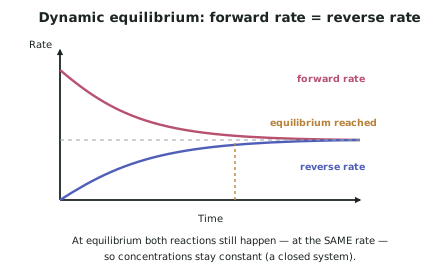
- As products build up, the reverse reaction speeds up while the forward reaction slows down (its reactants are being used).
- Eventually the two rates become equal. That is equilibrium.
What "dynamic" means
At equilibrium, the forward and reverse reactions are still happening — at the same rate.
-
The reactions have not stopped. Particles are still reacting in both directions, constantly.
-
But because the two rates are equal, product is being formed exactly as fast as it is being used up.
-
So the concentrations of everything stay constant, even though the reactions continue.
-
This is the single most-tested idea on the page: constant concentrations, not stopped reactions.
The three conditions for equilibrium
An equilibrium requires all three:
-
The system must be closed — nothing can enter or leave.
-
The forward and reverse rates must be equal.
-
The concentrations of reactants and products remain constant.
-
If the system is open, a product can escape (a gas, for instance), the reverse reaction never builds up, and equilibrium is never reached.
What equilibrium does not mean
- It does not mean the reaction has stopped.
- It does not mean there are equal amounts of reactants and products. The concentrations are constant, not equal — the position of equilibrium may lie well to one side.
- It does not mean nothing can change it. Alter the conditions and the system will shift.
The position of equilibrium
- If there is more product than reactant at equilibrium, the position lies to the right.
- If there is more reactant than product, it lies to the left.
- Changing the conditions shifts the position, which is the next page.
Worked ExampleExplaining what equilibrium means
A sealed flask contains a mixture of (colourless) and (brown) at equilibrium:
The brown colour of the mixture stays constant. A student says this proves the reaction has stopped. Explain why the student is wrong, and state what the constant colour actually shows.
Step 1 — Identify what the colour indicates
is brown and is colourless, so the intensity of the brown colour shows the concentration of .
A constant colour therefore means the concentration of is constant.
Step 2 — Explain why constant is not the same as stopped
A constant concentration only tells you that is being formed and used up at the same rate. It does not tell you that either process has stopped.
At equilibrium, both reactions are still occurring:
- the forward reaction is still converting into , and
- the reverse reaction is still converting back into .
Because the two rates are equal, every molecule formed is balanced by one being converted back, so the amount present does not change. This is why equilibrium is described as dynamic.
Step 3 — Say why the student's conclusion does not follow
If the reactions had genuinely stopped, the concentrations would also be constant — so the observation is consistent with the student's claim but does not prove it. The observation cannot distinguish between the two explanations on its own.
The reason we know the reactions continue is that disturbing the system produces an immediate response: warming the flask darkens the colour and cooling it lightens the colour, which could not happen if nothing were reacting.
Step 4 — State what the constant colour shows
The constant colour shows the system has reached dynamic equilibrium: the forward and reverse reactions are proceeding at equal rates, so the concentrations of and remain constant.