The equilibrium constant, Kc
What tells you
- The equilibrium constant measures how far a reaction goes before reaching equilibrium — the position of the equilibrium.
- It is calculated from the concentrations at equilibrium.
For the general reaction :
- Square brackets mean concentration in .
- Products go on top, reactants underneath.
- Each concentration is raised to the power of its coefficient in the balanced equation.
- The standard limits this to homogeneous systems — everything in the same phase (all gases, or all in solution).
Interpreting the value
| Meaning | Position of equilibrium | |
|---|---|---|
| large (≫1) | mostly products at equilibrium | lies to the right |
| about 1 | comparable amounts of both | roughly central |
| small (≪1) | mostly reactants at equilibrium | lies to the left |
- A large does not mean the reaction is fast. describes how far, not how quickly — rate is a separate question entirely.
What changes
-
Only temperature changes the value of .
-
Changing concentration or pressure shifts the position of the equilibrium, but the system adjusts so that ends up at the same value.
-
A catalyst changes neither.
-
So if a question says has changed, the temperature must have changed.
Writing the expression
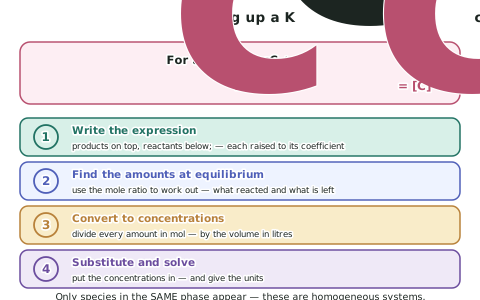
- Balance the equation first — the coefficients become the powers.
- Put the products on top and the reactants underneath.
- Raise each concentration to its coefficient.
Worked through:
-
gives
-
gives
Units
- The units of depend on the equation, so work them out from the expression each time.
- For the units cancel — has no units.
- For they do not cancel:
Worked ExampleWriting and interpreting Kc
For the equilibrium :
(a) Write the expression for and determine its units. (b) At 500 °C, . State what this tells you about the position of equilibrium. (c) State and explain what happens to if more is added.
(a) The expression and its units
Step 1 — Put the products on top, reactants underneath. The product is ; the reactants are and .
Step 2 — Raise each to the power of its coefficient. has coefficient 2, has coefficient 2, has coefficient 1.
Step 3 — Work out the units. Substituting for each concentration:
The squared terms cancel, leaving:
(b) Interpreting the value
, which is much greater than 1.
Since is products over reactants, a large value means the numerator is much larger than the denominator — there is a much higher concentration of products than reactants at equilibrium.
So the position of equilibrium lies well to the right, and the reaction produces a high yield of .
Note this says nothing about the rate — the reaction may still be slow, which is why a catalyst is used industrially.
(c) The effect of adding more
The value of does not change.
Adding increases the denominator, so momentarily the ratio falls below . By Le Chatelier's principle the system responds by shifting right, converting some of the added and into .
This increases the numerator and decreases the denominator until the ratio returns to exactly the same value as before.
So the position of equilibrium shifts right (more is formed), but is unchanged. Only a change in temperature would alter the value of .