Properties of acid and base solutions
The three properties
The standard restricts the properties of acid and base solutions to exactly three: conductivity, rate of reaction and pH.
All three follow from the same thing: how many ions the solution contains.
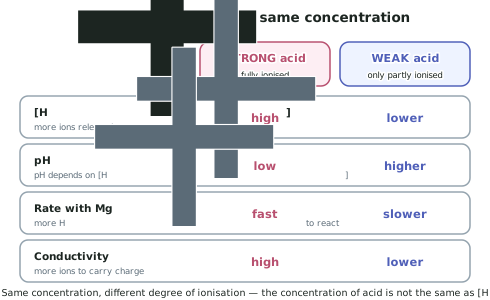
Comparing at the same concentration
Everything on this page assumes the two acids are at the same concentration — otherwise you are not comparing strength at all.
| Property | Strong acid | Weak acid | Why |
|---|---|---|---|
| high | lower | complete vs partial ionisation | |
| pH | low | higher | pH depends on |
| Rate with Mg | fast | slower | more to collide |
| Conductivity | high | lower | more ions to carry charge |
Conductivity
-
A solution conducts electricity if it contains ions that are free to move.
-
The more ions in the solution, the better it conducts.
-
A strong acid ionises completely, producing many ions, so it conducts well.
-
A weak acid ionises only partially, so most of it stays as neutral molecules and there are fewer ions — it conducts poorly.
-
Neutral molecules carry no charge, so they contribute nothing to conductivity.
Rate of reaction
-
Reactions of acids — with metals, carbonates, or in neutralisation — depend on the ions.
-
A higher means the hydrogen ions are closer together, so they collide with the other reactant more frequently, giving more successful collisions per second.
-
So a strong acid reacts faster than a weak acid of the same concentration.
-
But note carefully: the total amount of product is the same, because both contain the same total moles of acid. Only the speed differs — the weak acid's equilibrium keeps replacing the as it is used up.
pH
- pH is a measure of — the lower the pH, the higher the hydrogen ion concentration.
- A strong acid has a high and therefore a low pH.
- A weak acid of the same concentration has a lower and therefore a higher pH.
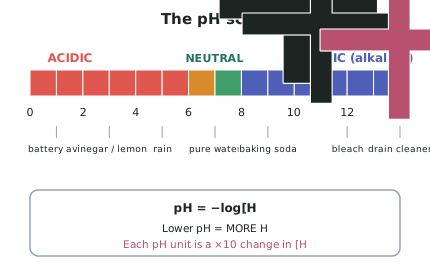
- Each pH unit is a tenfold change in : pH 2 has ten times the of pH 3, and a hundred times that of pH 4.
Bases work the same way
- A strong base (NaOH) dissociates completely, giving a high , a high pH and good conductivity.
- A weak base () reacts only partially with water, giving a lower , a lower pH (though still above 7) and poorer conductivity.
Using the properties as evidence
- Given measurements, you can work backwards: two solutions of the same concentration where one has a lower pH, faster reaction and higher conductivity — that one is the strong acid.
- All three properties point the same way, so they corroborate each other.
Worked ExampleIdentifying two acids from their properties
Two colourless solutions, X and Y, are both monoprotic acids. The following measurements are made:
| X | Y | |
|---|---|---|
| pH | 1.0 | 2.9 |
| Conductivity | high | low |
| Time for 20 mL of with excess Mg | 45 s | 210 s |
Identify which is the strong acid, explain each measurement, and predict the total volume of hydrogen each would eventually produce.
Step 1 — Use the pH to find
X has pH 1.0. For a monoprotic acid at , complete ionisation would give , which is exactly pH 1.0.
So X is fully ionised — it is the strong acid.
Y has pH 2.9, corresponding to — far below its acid concentration of .
So Y is only partially ionised — it is the weak acid.
Step 2 — Explain the conductivity
Conductivity depends on the number of ions free to move in the solution.
X ionises completely, so almost all of it is present as and its anion — many ions, so high conductivity.
Y ionises only partially, so most of it remains as neutral molecules, which carry no charge — few ions, so low conductivity.
Step 3 — Explain the reaction times
The reaction with magnesium depends on the concentration.
X has a much higher , so the hydrogen ions collide with the magnesium surface more frequently, giving more successful collisions per second. It reaches 20 mL of hydrogen in 45 s.
Y has a much lower , so collisions with the magnesium are less frequent and the reaction is slower — taking 210 s for the same volume.
Step 4 — Predict the total volume of hydrogen
Both would eventually produce the same total volume.
The magnesium is in excess, so the acid is limiting. Both solutions have the same concentration and volume, so they contain the same number of moles of acid, and each mole can donate one mole of .
For Y, as its is used up, the equilibrium
shifts right to replace the removed, so the un-ionised molecules act as a reserve and continue supplying protons until the acid is exhausted.