Catalysts
What a catalyst is
- A catalyst increases the rate of a reaction without being used up.
- It is present at the end in the same amount and the same chemical form as at the start.
- Because it is not consumed, a small amount can catalyse a large quantity of reaction, over and over.
How it works
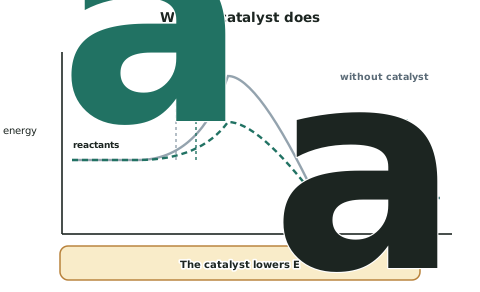
A catalyst provides an alternative reaction pathway with a lower activation energy.
-
With a lower barrier, a greater proportion of collisions has at least the activation energy.
-
More collisions are therefore successful, and the rate increases.
-
Note the wording: the catalyst does not lower the activation energy of the original route. It offers a different route with a lower barrier.
What a catalyst does not do
This list is where most marks are lost, so learn it deliberately. A catalyst does not:
- get used up — it is unchanged at the end;
- change — the reactants and products are the same, so the energy difference between them is the same;
- change the amount of product formed — only how quickly it forms;
- make the particles collide more often;
- shift the position of an equilibrium — it speeds up the forward and reverse reactions equally, so equilibrium is simply reached sooner.
Reading the energy profile
- Both curves start at the same reactant level and end at the same product level.
- The catalysed curve has a lower peak — that is the lower activation energy.
- The vertical gap between start and finish is identical on both curves — that is , unchanged.
Why industry uses catalysts
- A catalyst lets a process run fast enough to be economic at a lower temperature, saving energy and cost.
- For a reversible exothermic reaction this matters twice over: raising the temperature would speed the reaction up but shift the equilibrium towards the reactants, lowering the yield. A catalyst raises the rate without that penalty.
- Enzymes are biological catalysts; catalytic converters use platinum and rhodium to treat exhaust gases.
Worked ExampleEvaluating a claim about catalysts
A student writes: "Adding a catalyst speeds up the reaction because it lowers the activation energy, and it also increases the amount of product because more reactant is converted."
Identify what is correct and what is wrong, and give a fully correct explanation.
Step 1 — What is correct
The claim that the reaction speeds up is correct, and the reference to activation energy is on the right track.
A catalyst does increase the rate, by providing an alternative reaction pathway with a lower activation energy. With a lower barrier, a greater proportion of collisions has at least the activation energy, so more collisions succeed per second and the rate increases.
The wording could be sharper — a catalyst does not lower the activation energy of the original pathway, it offers a different route with a lower one — but the idea is sound.
Step 2 — What is wrong
The second half is incorrect. A catalyst does not increase the amount of product.
The amount of product is set by the amount of reactant available — specifically by the limiting reactant. A catalyst changes how quickly the reactants are converted, not how much reactant there is to convert.
Step 3 — Why the misconception arises
On a graph of product against time, a catalysed reaction gives a steeper curve, which can look like "more product". But both curves level off at the same height, because the same amount of reactant was used. The catalysed reaction simply reaches that height sooner.
Step 4 — The complete correct statement
A catalyst increases the rate by providing an alternative pathway with a lower activation energy, so a greater proportion of collisions has enough energy to react. It is not used up, it does not change , and it does not change the amount of product — the reaction simply reaches the same final amount more quickly.