Collision theory and activation energy
What rate means
- The rate of reaction is how quickly reactants are used up or products are formed.
- A fast reaction produces its products in a short time; a slow one takes longer.
The three conditions for a reaction
For two particles to react, all three must be true:
- They must collide.
- The collision must have at least a minimum energy — the activation energy.
- They must collide with the correct orientation.
- A collision meeting all three conditions is a successful collision.
- Most collisions are not successful — the particles bounce apart unchanged.
Rate depends on successful collisions
The rate depends on the frequency of successful collisions, and there are only two ways to increase that:
-
Increase how often particles collide — more collisions per second.
-
Increase the fraction of collisions that have enough energy — a greater proportion succeeds.
-
Every factor in this topic works through one or both of these. Naming which one is what earns the Merit mark.
Activation energy
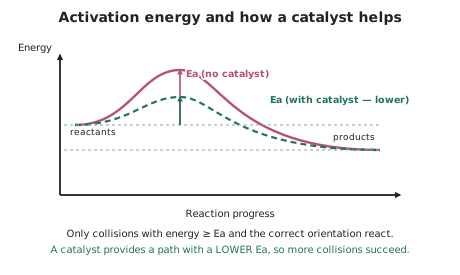
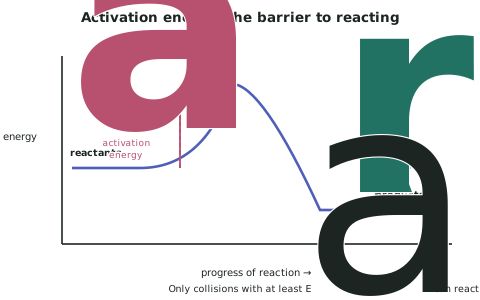
- Activation energy () is the minimum energy colliding particles must have in order to react.
- It is a barrier: particles colliding with less than simply bounce apart without reacting.
-
A high activation energy means few collisions have enough energy, so the reaction is slow.
-
A low activation energy means many collisions succeed, so the reaction is fast.
-
This is why methane and air can sit unreacted indefinitely: the reaction is very exothermic, but its activation energy is high, so ordinary collisions cannot get over the barrier until a spark supplies the energy.
and are different things
- is the height of the barrier between reactants and products. It controls the rate.
- is the difference in level between reactants and products. It controls how much energy is released or absorbed.
- A reaction can be strongly exothermic and extremely slow, because a big energy release is no help if particles cannot get over the barrier.
Measuring a rate
- Follow something that changes as the reaction proceeds:
- volume of gas produced,
- mass lost as gas escapes,
- time for a colour or a cross to disappear.
- Plot the measurement against time. The steeper the curve, the faster the rate.
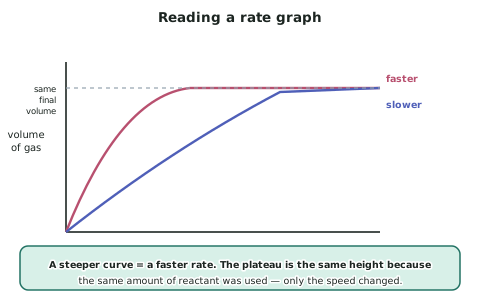
- The curve flattens when a limiting reactant has been used up.
- Changing the conditions changes the steepness; it changes the final height only if the amount of reactant changes.
Worked ExampleExplaining the shape of a rate curve
A student reacts marble chips with hydrochloric acid and measures the volume of carbon dioxide produced. The curve is steep at first, becomes less steep, and finally flattens out. Explain the shape in terms of collision theory.
Step 1 — Explain the steep start
At the beginning the concentration of hydrochloric acid is at its highest, and the marble chips are at their largest.
A high concentration means the acid particles are close together, so they collide with the marble surface frequently.
Frequent collisions → many successful collisions per second → the rate is fast, so the curve is steep.
Step 2 — Explain the flattening middle
As the reaction proceeds the acid is used up, so its concentration falls. The chips also get smaller, reducing the surface area available.
Fewer acid particles in the same volume means they collide with the marble less often, so there are fewer successful collisions per second and the rate decreases. The curve becomes less steep.
Step 3 — Explain the flat end
Eventually one reactant is completely used up — the limiting reactant.
With none of it left, no further collisions between reactants can occur, so no more product forms. The volume stops increasing and the curve becomes horizontal.
Step 4 — Say what the final height means
The height of the flat section is the total volume of gas produced, which is set by the amount of the limiting reactant — not by how fast the reaction went.