Acids and bases as proton transfer
The definitions
The standard defines acids and bases in terms of proton transfer:
-
An acid is a proton donor — it gives away an ion.
-
A base is a proton acceptor — it takes an ion.
-
A proton here means a hydrogen ion, — a hydrogen atom that has lost its electron is just a proton.
-
Every acid–base reaction is therefore an moving from one species to another.
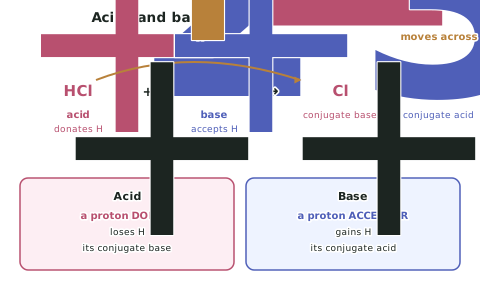
An acid needs a base
- An acid can only donate a proton if something is there to accept it.
- So acids and bases always act together — you never have one acting alone.
When an acid dissolves in water, water acts as the base:
-
HCl donates a proton → it is the acid.
-
accepts it → it is the base.
-
is the hydronium ion (also called the oxonium ion).
-
You will often see this written more simply as . Both are acceptable; the full version shows what the proton actually attaches to.
Conjugate pairs
- When an acid donates its proton, what is left is its conjugate base.
- When a base accepts a proton, what it becomes is its conjugate acid.
- A conjugate pair differs by exactly one .
- Here the pairs are HCl / and / .
Finding a conjugate
-
Conjugate base — remove one : take away one H and make the charge one more negative.
-
Conjugate acid — add one : add one H and make the charge one more positive.
-
Watch the charge, not just the hydrogen. Removing from a neutral molecule leaves a 1− ion.
Species that can do both
- Some species can donate or accept a proton, depending on what they meet.
- Water is the important example:
- With an acid it accepts a proton, acting as a base:
- With a base it donates one, acting as an acid:
Bases and alkalis
- A base is any proton acceptor.
- An alkali is a base that is soluble in water, producing ions in solution.
- All alkalis are bases; not all bases are alkalis.
Worked ExampleIdentifying acids, bases and conjugate pairs
For the reaction below, identify the acid, the base, the conjugate acid and the conjugate base, and state the two conjugate pairs.
Step 1 — Track what happens to each species
Compare each species on the left with what it becomes on the right.
- becomes — it has gained an H and become more positive. It accepted a proton.
- becomes — it has lost an H and become more negative. It donated a proton.
Step 2 — Assign acid and base
- The species that donated the proton is the acid: .
- The species that accepted it is the base: .
Note that water is acting as the acid here, even though it acts as a base with HCl. What it does depends on its partner.
Step 3 — Assign the conjugates
- (base) accepted a proton to become , which is its conjugate acid.
- (acid) donated a proton to become , which is its conjugate base.
Step 4 — State the conjugate pairs
A conjugate pair differs by exactly one :
- / — base and its conjugate acid.
- / — acid and its conjugate base.
Step 5 — Check the charges balance
Left: . Right: . ✓