pH and Kw calculations
The ionic product of water
- Water itself ionises very slightly:
- The product of the two ion concentrations is a constant, :
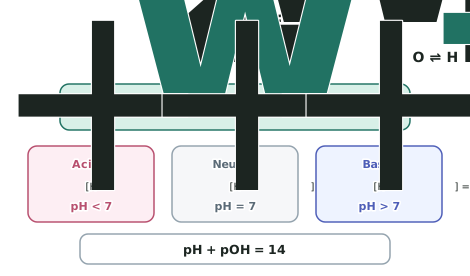
- This holds in every aqueous solution, not just pure water. Knowing one ion concentration therefore always gives you the other.
| Relationship | pH | |
|---|---|---|
| Acidic | < 7 | |
| Neutral | = 7 | |
| Basic | > 7 |
The relationships you need
- These are given on the resource booklet. The marks are for choosing the right one and using it correctly.
Important scope limit
pH calculations in this standard are restricted to strong acids and bases.
- Because a strong acid ionises completely, its equals its concentration (for a monoprotic acid), so you can go straight to the pH.
- You will not be asked to calculate the pH of a weak acid from its concentration — that requires , which is Level 3.
Strong acids
- Monoprotic (HCl, ) — donates one per molecule, so the acid concentration.
- Diprotic () — donates two, so the acid concentration.
Worked through for HCl:
Strong bases
A base gives you , so there is an extra step. There are two routes — use whichever you find easier:
- Route 1, via : find , then take .
- Route 2, via pOH: find , then .
Worked through for NaOH:
- Route 1: , so
- Route 2: , so ✓
Significant figures in pH
- pH is a logarithm, so the digits before the decimal point come from the power of ten and are not significant figures.
- The number of decimal places in a pH should match the number of significant figures in the concentration.
- (2 s.f.) → pH = 2.00 (2 d.p.)
The method
- Identify whether you have an acid or a base, and whether it is strong.
- Find — directly for an acid, or via / pOH for a base.
- Watch for diprotic acids — double the concentration.
- Apply .
- Round to the right number of decimal places.
Worked ExampleTwo pH calculations
(a) Calculate the pH of nitric acid, . (b) Calculate the pH of sodium hydroxide, NaOH.
(a) nitric acid
Step 1 — Identify the type of acid. is a strong, monoprotic acid — it ionises completely and donates one per molecule:
Step 2 — Find . Because ionisation is complete and one proton is donated per molecule, the hydrogen ion concentration equals the acid concentration:
Step 3 — Apply the pH relationship.
Step 4 — Check it is sensible. An acid should give a pH below 7. ✓ And 1.60 lies between 1 and 2, which fits a concentration between and . ✓
pH = 1.60 (2 d.p., matching the 2 s.f. in the concentration).
(b) sodium hydroxide
Step 1 — Identify what you have been given. NaOH is a strong base and dissociates completely, giving one per formula unit:
Note this is , not — the extra step is what the question is testing.
Step 2 — Convert to using .
Step 3 — Apply the pH relationship.
Step 4 — Check using the other route.
Step 5 — Check it is sensible. A base should give a pH above 7. ✓
pH = 11.70