Randomness and what it looks like
What randomness means
- Randomness is named as a method in its own right in the explanatory notes, and questions on it ask for explanation rather than calculation.
- An outcome is random if:
- the individual outcome is unpredictable, but
- the long-run pattern is predictable.
- Both halves matter. A process that is unpredictable and has no stable long-run pattern is not something probability can describe at all.
The two properties, applied
- Individually unpredictable. You cannot know whether the next customer will buy. Nothing about the previous customers tells you.
- Predictable in aggregate. Over 10 000 customers, the proportion who buy will be close to a stable value.
- This is why insurers, airlines and supermarkets can plan precisely while knowing nothing about any individual.
What random variation actually looks like
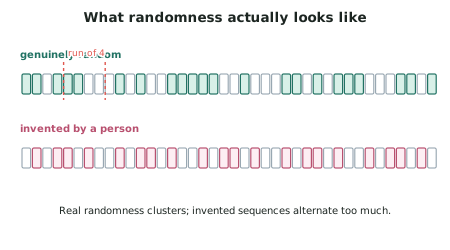
- Real randomness contains clusters and runs. In 40 coin tosses, a run of five heads is common — it occurs more often than not.
- People asked to invent a random sequence produce something too regular: they alternate too often and avoid long runs, because runs feel non-random.
- Consequences you should be able to explain:
- A cluster of events — three house fires in one street in a month, four rainy Saturdays in a row — is not evidence of a cause. Clusters are what randomness looks like.
- Conversely, a sequence that looks too even is evidence that something is not random.
The gambler's fallacy
- The gambler's fallacy is believing that a run of one outcome makes the other "due".
- After five heads, the probability of a head on the sixth toss is still 0.5. The coin has no memory.
- Why it feels wrong: the law of large numbers says the proportion settles down over the long run — but it does so by dilution, not by compensation. Later tosses do not correct earlier ones; there are simply so many later tosses that the early imbalance stops mattering.
- The reverse fallacy also appears: assuming a run means the process is "hot" and will continue.
Independence and randomness are not the same
- Random describes a single outcome being unpredictable with a stable long-run pattern.
- Independent describes a relationship between two events — one occurring does not change the probability of the other.
- Random events can be dependent. Drawing cards without replacement is random at every step, and each draw changes the probabilities for the next.
Generating randomness
- A process is random only if the mechanism makes it so:
- Drawing numbered balls from a well-mixed drum.
- Assigning each unit a random number from a calculator or spreadsheet and sorting.
- Common failures that look random and are not:
- Choosing "at random" by hand — humans avoid adjacent numbers, favour middle numbers, and avoid repeats.
- Taking whoever is available — convenience, not randomness.
- Using a pattern such as every 10th — systematic, and non-random if the list has structure.
Simulation
- A simulation models a random situation using a random mechanism, runs it many times, and uses the resulting relative frequency as an experimental estimate.
- Steps you may be asked to describe:
- Define the model and the assumption it makes.
- Assign random digits or outcomes to represent each event in the correct proportion.
- Run many trials.
- Count and divide to get the estimate.
- A simulation's answer is an experimental estimate, so it varies between runs and improves with more trials.
Worked ExampleRecognising randomness and its consequences
A hardware chain's website reports a fault on some days and not others. Over the last 30 days the faults occurred on days:
The IT manager says: "Faults are clustered — days 3–5 and days 25–28 both had runs. Something must be causing them in groups, so this is not random. Also, we've had four days in a row of faults, so we're due a quiet spell."
(a) Calculate the experimental estimate of the probability that a given day has a fault. (b) Comment on the manager's claim that the clustering shows the faults are not random. (c) Comment on the "due a quiet spell" claim. (d) What evidence would genuinely show the faults are not occurring at random?
(a) Experimental estimate
There were 10 fault days out of 30:
(b) Does clustering disprove randomness?
Step 1 — State what random data look like. Random events cluster. If each day independently has a fault with probability , then runs of consecutive fault days are not merely possible but expected. The probability of a fault on any three specific consecutive days is — and across 30 days there are 28 places such a run could start, so seeing at least one run of three is unsurprising.
Step 2 — Address the psychology. People expect randomness to look evenly spread, so genuinely random data appear "clustered" to the eye. An evenly spaced pattern — faults on days 3, 6, 9, 12, 15… — would be far stronger evidence against randomness than what was observed.
Step 3 — Conclude.
Note this does not prove the faults are random — only that this particular observation gives no reason to think otherwise.
(c) The "due a quiet spell" claim
Step 1 — Name the error. This is the gambler's fallacy.
Step 2 — Explain why it is wrong. If days are independent, the probability of a fault tomorrow is regardless of what happened on the previous four days. The system has no mechanism for tracking its recent history and compensating.
Step 3 — Address the intuition behind it.
Step 4 — Note the assumption.