Mutually exclusive events and independence
Two different ideas that sound similar
- Mutually exclusive and independent are both named in the explanatory notes, they both concern a pair of events, and they mean completely different things.
- Confusing them is the most common conceptual error at this level.
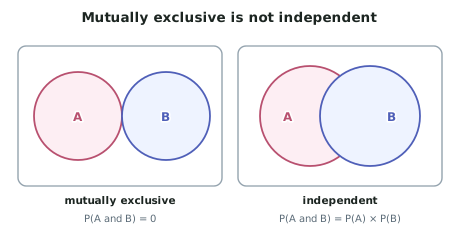
| Mutually exclusive | Independent | |
|---|---|---|
| Meaning | They cannot both happen | One happening does not change the chance of the other |
| Test | ||
| Venn diagram | Circles do not overlap | Circles do overlap (in general) |
| Addition rule becomes | No simplification | |
| Example | A single die shows a 3 / shows a 5 | First die shows 3 / second die shows 5 |
Mutually exclusive events
- Events are mutually exclusive if they cannot occur together:
- Because the overlap is zero, the addition rule simplifies:
- Examples: a person is aged 15–19 or aged 20–24; a single card is a heart or a spade; a customer pays by cash or by card (if only one method is allowed).
- Exhaustive is a different word again: a set of events is exhaustive if between them they cover the whole sample space. A set that is both mutually exclusive and exhaustive is a partition, and its probabilities sum to 1.
Independent events
- Events are independent if knowing one occurred does not change the probability of the other:
- The multiplication form is the practical test. To show two events are independent, compute and compare it with . If they are equal, the events are independent; if not, they are not.
- Examples: two tosses of a coin; the weather in Invercargill today and the result of a rugby match in Hamilton; drawing a card with replacement.
Why mutually exclusive events are not independent
- This catches almost everyone, so reason it through once and remember the argument.
- Suppose and are mutually exclusive with and .
- If you know has happened, then cannot have happened, so .
- But . So , and the events are dependent.
Mutually exclusive events are about as dependent as two events can be — one occurring tells you with certainty that the other did not.
Checking independence from data
- Given a two-way table or a set of probabilities, the procedure is fixed:
- Compute , and .
- Compare with .
- Equal → independent. Not equal → not independent, and the direction tells you more:
- → the events are positively associated (each makes the other more likely)
- → negatively associated.
- Always state the conclusion in context, and where the numbers come from data, note that small departures may reflect sampling variability rather than genuine dependence.
Independence in a real context is an assumption, not a fact
- Questions frequently ask whether an independence assumption is reasonable. Look for a shared cause:
- Two people in the same household catching an illness — not independent.
- Two flights on the same day in the same weather — not independent.
- Two components from the same production batch failing — not independent.
- The test to apply: is there anything that would affect both at once? If yes, they are dependent.
Worked ExampleTesting independence and exclusivity
A survey of 500 Year 13 students records whether each has a part-time job and whether each plays a school sport.
| Plays sport | No sport | Total | |
|---|---|---|---|
| Has a job | 108 | 132 | 240 |
| No job | 117 | 143 | 260 |
| Total | 225 | 275 | 500 |
(a) Are "has a job" and "plays sport" mutually exclusive? Explain. (b) Determine whether the two events are independent. (c) A second school reports that of its 400 students, 160 have a job, 180 play sport, and 50 do both. Test independence for this school and interpret the result in context.
(a) Mutually exclusive?
Step 1 — Apply the definition. Two events are mutually exclusive if they cannot both occur, that is .
Step 2 — Read the overlap from the table. 108 students both have a job and play sport, so
(b) Independent?
Step 1 — Find the individual probabilities.
Step 2 — Find the joint probability.
Step 3 — Apply the test.
Step 4 — Compare.
Step 5 — Confirm with the conditional form.
The proportion playing sport is 45% among job-holders and 45% overall — exactly what independence means.
(c) The second school
Step 1 — Find the probabilities.
Step 2 — Apply the test.
Step 3 — Compare.
Step 4 — Quantify the association.
Among students with a job, 31% play sport; among students overall, 45% do.
Step 5 — Interpret in context.
Step 6 — Compare the two schools.