Reversing a conditional probability
The most examined idea in the standard
- and are different numbers answering different questions, and treating them as the same is the most common serious error in probability — in exams and in public life.
- Two statements that sound alike but are not:
- "Of people with the disease, 99% test positive." →
- "Of people who test positive, 99% have the disease." →
- The first can be true while the second is wildly false. Which one holds depends on how common the disease is.
Why the base rate decides everything
- The reason the two differ is that they have different denominators, and those groups can be wildly different in size.
- If a disease affects 1 person in 1 000, then out of 1 000 people:
- the "has the disease" group has 1 member
- the "tests positive" group may have 50, because a small error rate applied to 999 healthy people produces many false positives.
- A small percentage of a huge group beats a large percentage of a tiny one. This is the whole idea, and it is worth carrying as a sentence.
The method: natural frequencies
- The reliable way to reverse a conditional probability is not a formula. It is to imagine a large population and count.
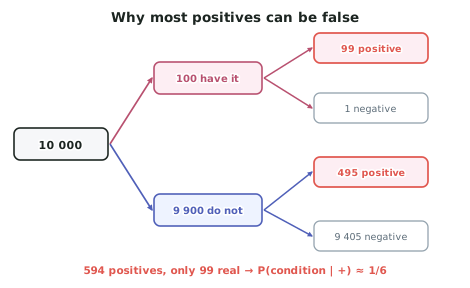
- The four steps:
- 1. Choose a convenient population — 10 000 or 100 000 works well.
- 2. Split by the condition using the base rate.
- 3. Apply the conditional probabilities within each branch.
- 4. Build the group you are conditioning on and take the fraction.
- This turns a confusing problem into arithmetic you can check, and it makes the answer explicable — which matters, because these questions almost always ask for an interpretation.
The vocabulary of testing
| Term | Meaning | Symbol |
|---|---|---|
| Sensitivity | Of those with the condition, the proportion testing positive | |
| Specificity | Of those without it, the proportion testing negative | |
| False positive | Tests positive but does not have it | counted in |
| False negative | Tests negative but does have it | counted in |
| Positive predictive value | Of those testing positive, the proportion who have it |
- Sensitivity and specificity are properties of the test. The positive predictive value is not — it depends on how common the condition is in the group being tested.
- This is why the same test performs very differently as a screening tool (whole population, low base rate, many false positives) and as a diagnostic tool (people already showing symptoms, higher base rate, far fewer false positives).
The formula, if you want it
- The reversal can be written as:
- where comes from the law of total probability. You are not required to use this form, and natural frequencies are both safer and more explicable. Use the formula only as a check.
Where this appears outside exams
- Medical screening — the classic case above.
- Drug and alcohol testing in workplaces, where a rare true rate makes most positives false.
- Security and fraud screening, where flagging rare events produces overwhelming false alarms.
- Courtroom reasoning — confusing "the probability of this evidence if the person is innocent" with "the probability the person is innocent given this evidence".
- Everyday reasoning — "most burglars wear dark clothing" does not make most people in dark clothing burglars.
Worked ExampleScreening for a rare condition
A screening test for a condition affecting 1% of the population has:
- sensitivity 99% — of those with the condition, 99% test positive
- specificity 95% — of those without it, 95% test negative.
A person from the general population is screened and tests positive.
(a) Find the probability that they actually have the condition. (b) Explain why the answer is so much lower than the test's 99% sensitivity. (c) The test is later used only on patients referred by a doctor because they show symptoms, among whom the condition affects 30%. Recalculate and comment.
(a) Building the natural frequency table
Step 1 — Choose a population. Take 10 000 people.
Step 2 — Split by the condition using the base rate of 1%.
Step 3 — Apply the test within each group.
Of the 100 with the condition, sensitivity 99% means:
Of the 9 900 without, specificity 95% means 95% test negative, so 5% test positive:
Step 4 — Assemble the table.
| Tests positive | Tests negative | Total | |
|---|---|---|---|
| Has condition | 99 | 1 | 100 |
| No condition | 495 | 9 405 | 9 900 |
| Total | 594 | 9 406 | 10 000 |
Step 5 — Condition on testing positive. The conditioning group is the 594 people who tested positive. Of those, 99 actually have the condition.
(b) Why so low?
Step 1 — Compare the two groups the positives come from.
Step 2 — State the principle.
Step 3 — Note what the test still achieves.
(c) Using the test on referred patients
Step 1 — Rebuild with a base rate of 30%. Take 10 000 referred patients.
Step 2 — Condition on positive.
Step 3 — Comment.
Step 4 — Reflect on the policy implication.