Two-way tables
Why the table is usually the right tool
- A two-way table classifies every member of a group by two variables at once. It is the most useful representation in this standard because every probability you need can be read straight off it — you only have to choose the right denominator.
- Use a two-way table when the information comes as counts or percentages of a whole group. Use a tree instead when the information comes as a sequence of stages with conditional probabilities given.
Anatomy of the table
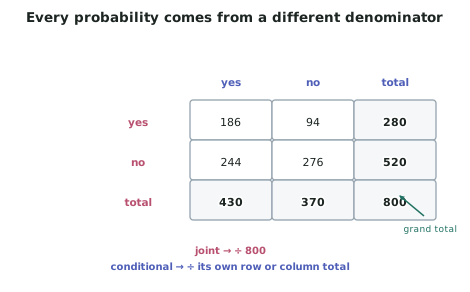
- The inner cells hold the counts for each combination.
- The row and column totals are the marginal totals.
- The grand total in the corner is the size of the whole group.
- Always fill in every total before you start. Most errors in this topic come from using the wrong denominator, and having all the totals visible prevents that.
The three kinds of probability from one table
- This is the heart of the topic. Each uses a different denominator.
| Type | Question it answers | Denominator |
|---|---|---|
| Marginal | — chance of for a random member of the whole group | Grand total |
| Joint | — chance of both | Grand total |
| Conditional | — chance of given | The total for |
- Marginal and joint probabilities both divide by the grand total; only the numerator changes.
- A conditional probability restricts attention to one row or one column, and that row or column total becomes the new denominator.
Spotting a conditional probability in words
- The phrases that signal a conditional probability, and what the denominator becomes:
- "given that they are…" → the given group
- "of those who…" → the group named after "of"
- "among the…" → that group
- "a randomly chosen [member of a group]…" → that group
- Compare carefully:
- "the probability a randomly chosen student is female and studies physics" → joint, denominator = all students
- "the probability a randomly chosen female student studies physics" → conditional, denominator = female students
- "the probability a randomly chosen physics student is female" → conditional the other way, denominator = physics students.
Filling in a partly complete table
- Exam questions frequently give a few figures and ask you to complete the table. The method is always the same:
- Convert any percentages to counts using the grand total.
- Fill what you are given.
- Use row total − known cell and column total − known cell to fill the rest.
- Check: every row sums to its row total, every column to its column total, and the totals to the grand total.
Testing independence from a table
- Compute , and from the table and compare with .
- Equivalently — and often faster — compare a conditional with its marginal: if , the events are independent.
- Reading independence off a table quickly: the events are independent exactly when each row shows the same proportions as the overall totals.
Worked ExampleReading every probability from one table
A council surveys 800 residents about a proposed library extension, recording their response and whether they have children at home.
| Support | Oppose | Undecided | Total | |
|---|---|---|---|---|
| Children at home | 186 | 54 | 40 | 280 |
| No children at home | 244 | 206 | 70 | 520 |
| Total | 430 | 260 | 110 | 800 |
A resident is chosen at random.
(a) Find the probability the resident supports the extension. (b) Find the probability the resident has children at home and opposes it. (c) Find the probability the resident supports it given they have children at home. (d) Find the probability the resident has children at home given they support it. (e) Are "supports the extension" and "has children at home" independent?
(a) Marginal probability — denominator is the grand total
(b) Joint probability — denominator is still the grand total
Read the single cell where "children at home" meets "oppose": 54.
(c) Conditional — restrict to the "children at home" row
Step 1 — Identify the conditioning group. "Given they have children at home" means the denominator is the row total, 280, not 800.
Step 2 — Read the numerator from within that row. Of those 280, 186 support.
(d) The reverse conditional — restrict to the "support" column
Step 1 — Notice this is a different question. Now the conditioning group is supporters, so the denominator is the column total, 430.
Step 2 — Read the numerator. Of those 430 supporters, 186 have children at home.
Compare (c) and (d). Both use the same cell — 186 — but different denominators, and they give very different answers: 0.664 against 0.433. This is the reversal error in miniature, and it is the most examined idea in the standard.
(e) Independence
Step 1 — Assemble the three probabilities.
Step 2 — Apply the test.
Step 3 — Compare.
Step 4 — Confirm with the conditional form and interpret.