Probability trees
When a tree is the right tool
- A probability tree is the representation for situations that happen in stages: a first event, then a second, then possibly a third.
- Use a tree when the question gives you conditional probabilities — "if it rains, the probability the ferry is cancelled is 0.4" — because those are exactly what the second-stage branches hold.
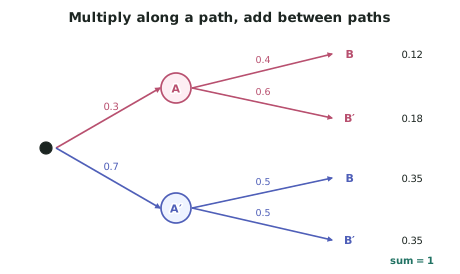
The two rules
-
Multiply along a path to get the probability of that complete sequence of events.
-
Add between paths when more than one path gives the outcome you want.
-
Formally, multiplying along a path is the conditional probability rule rearranged:
- The second-stage branches are conditional probabilities. The number on a branch from node is — the probability of given that has already happened.
Checks that catch errors
- The branches at every node sum to 1. If they do not, you have made an error or misread a probability.
- All the complete path probabilities sum to 1, because the paths are mutually exclusive and exhaustive.
- Do both checks. They take seconds and catch almost everything.
With and without replacement
- This distinction changes the second-stage probabilities and is very frequently examined.
| With replacement | Without replacement | |
|---|---|---|
| The item is returned | Yes | No |
| Second-stage probabilities | Unchanged | Changed — both numerator and denominator shift |
| The two draws are | Independent | Dependent |
- Without replacement, reduce both parts of the fraction. Drawing from 12 items of which 5 are red: after drawing a red, the next draw has 4 red out of 11.
- Read the wording carefully. "Two students are chosen" almost always means without replacement — the same student cannot be chosen twice.
"At least one" on a tree
- Use the complement rather than adding several paths:
- On a tree, "none" is usually a single path, so this converts three or four multiplications and an addition into one multiplication and a subtraction.
Trees with unequal stages
- The stages need not have the same number of branches, and a branch may end early if the process stops.
- A quality inspection that stops as soon as a fault is found produces a tree where one branch terminates at each stage.
- Label every branch with its probability and every endpoint with the outcome. An unlabelled tree earns little, because the representation is itself part of what is assessed.
Trees versus tables
- The two representations hold the same information in different forms, and questions sometimes require converting between them.
- Tree → table: each complete path probability becomes a cell of the table.
- Table → tree: first-stage branches are the marginal probabilities; second-stage branches are the conditionals, found by dividing each cell by its row total.
- If a question gives conditional probabilities and asks for a reversed conditional, the usual route is: build the tree, compute the path probabilities, then divide. That is the subject of the next page.
Worked ExampleA two-stage tree without replacement
A kapa haka group has 14 members: 9 seniors and 5 juniors. Two members are chosen at random, one after the other, to represent the group at a regional event.
(a) Draw a probability tree for the two selections. (b) Find the probability that both chosen members are seniors. (c) Find the probability that exactly one is a junior. (d) Find the probability that at least one is a junior. (e) The teacher instead decides to choose one member at random, record their name, return them to the pool, and choose again. Recalculate (d) and comment on the difference.
(a) The tree
Step 1 — First selection. From 14 members:
Check: ✓
Step 2 — Second selection. The first member is not returned, so there are only 13 left, and the composition depends on who was chosen first.
- After a senior: 8 seniors and 5 juniors remain →
- After a junior: 9 seniors and 4 juniors remain →
Both pairs sum to 1 ✓
(b) Both seniors — multiply along the path
(c) Exactly one junior — add two paths
Step 1 — Identify the paths. "Exactly one junior" happens as senior then junior or junior then senior.
Step 2 — Add between paths.
Note the two paths have equal probability. This is not a coincidence — the numerators are the same product in a different order.
(d) At least one junior — use the complement
Step 1 — Identify the complement. "At least one junior" is the opposite of "no juniors", which is the single path SS already found in (b).
Check by the long route: ✓
Also confirm the four paths sum to 1: ✓
(e) With replacement
Step 1 — The second-stage probabilities no longer change. Because the member is returned, the pool is 14 both times, and the two selections are independent.
Step 2 — Explain the difference.
Step 3 — Comment on which design is appropriate here.