Basic rules and the addition rule
The language
- An experiment is any process with an uncertain outcome.
- The sample space is the set of all possible outcomes.
- An event is a set of outcomes you are interested in — it may contain one outcome or many.
- denotes the probability of event .
The rules that hold always
- Every probability lies between 0 and 1:
- means the event cannot happen; means it is certain. An answer outside this range is always an error — check it every time.
- The probabilities of all outcomes in the sample space sum to 1.
- The complement rule. (read "not ") is everything in the sample space that is not :
- The complement rule is the most useful shortcut in the standard. Whenever a question says "at least one", the fast route is almost always .
The addition rule
- To find the probability that or occurs (meaning , or , or both):
- This is given in the Formulae and Tables Booklet.
- Why subtract the overlap. Adding and counts everything in both events twice, so the overlap must be removed once.
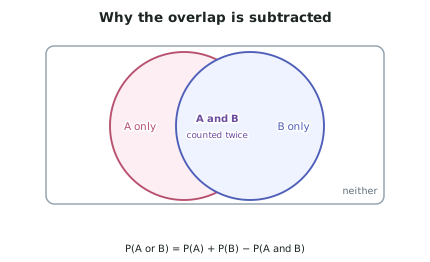
- Notation you will meet: means " or " (union), means " and " (intersection).
Reading "or" and "and" correctly
- In probability, "or" is inclusive — or includes the case where both happen. Everyday English often means "one or the other but not both", and questions exploit this.
- "and" means both occur together.
- If a question genuinely means exactly one of the two:
"At least one" — use the complement
- The complement of "at least one" is "none", and "none" is usually a single easy calculation.
- For three independent events each with probability of occurring:
- Doing this the long way — adding the probabilities of exactly one, exactly two and exactly three — is slow and error-prone, and the specification warns that laborious methods may not show the required thinking.
Checking your answer
- Three checks that catch most errors, and take seconds:
- Is the answer between 0 and 1?
- Is it sensible in context? A probability of 0.97 for something described as rare is a signal you have inverted something.
- Do the parts of a partition sum to 1?
Worked ExampleApplying the addition and complement rules
A café records that of its morning customers:
- 62% buy a hot drink
- 35% buy food
- 24% buy both
A morning customer is selected at random.
(a) Find the probability the customer buys a hot drink or food. (b) Find the probability the customer buys neither. (c) Find the probability the customer buys exactly one of the two. (d) Three morning customers are selected at random. Find the probability that at least one buys food, stating any assumption.
(a) Hot drink or food
Step 1 — Write down what is given.
Step 2 — Apply the addition rule. The overlap must be subtracted, because customers buying both are counted in and in .
Sanity check: without subtracting the overlap we would have got 0.97, which would imply almost every customer buys something — clearly wrong given that 24% buy both.
(b) Neither
Step 1 — Recognise the complement. "Neither" is the complement of "hot drink or food".
(c) Exactly one
Step 1 — Understand what to remove. " or " includes the customers who bought both. To get exactly one, remove them:
Step 2 — Check by an alternative route. Buy a drink only: . Buy food only: . Sum: . ✓
Check the whole partition: ✓
(d) At least one of three buys food
Step 1 — Use the complement. The complement of "at least one buys food" is "none of the three buys food".
Step 2 — Find the probability one customer does not buy food.
Step 3 — Combine, stating the assumption.
Assuming the three customers are independent — one customer's purchase does not affect another's:
Step 4 — Take the complement.
Step 5 — Comment on the assumption.