Real and nominal indicators
The distinction the standard names
- A nominal value is measured in the money of the day — the number written on the payslip, the price tag or the bank statement.
- A real value is that same figure adjusted for inflation — what it is actually worth in terms of goods and services.
- The standard lists "real versus nominal indicators" as an examinable concept, and the exam applies it to wages, interest rates and GDP.
The one relationship you must be able to use
- The approximation used at Level 2 is:
- Applied to wages:
- Nominal wage — the dollar amount you are paid.
- Real wage — what that pay actually buys.
- If nominal wages rise 4% while inflation is 6%, real wages have fallen by about 2%. The worker is paid more dollars and is worse off.
Real wages
- Real wages rise only when nominal wage growth exceeds inflation.
- Real wages fall when inflation outruns wage growth — even though the number on the payslip went up.
- This is why "I got a pay rise" and "I am better off" are different claims, and the exam has asked exactly this (2022: a 4.3% nominal rise against 7.3% inflation).
Real interest rates
- Nominal interest rate — the rate the bank advertises.
- Real interest rate — the nominal rate minus inflation; the true reward for saving or true cost of borrowing.
- A 6% savings rate with 7% inflation is a real interest rate of about −1%. The saver's balance grows, but it buys less than it did.
- The same arithmetic explains why borrowers gain from unexpected inflation: they repay a fixed number of dollars that are each worth less.
Real GDP
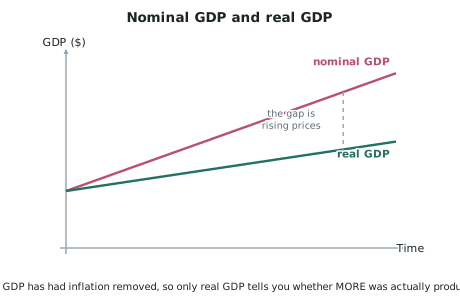
- Nominal GDP rises when either prices rise or output rises — it cannot tell you which.
- Real GDP has inflation stripped out, so it changes only when output changes.
- Only real GDP tells you whether the country actually produced more, which is why economic growth is measured in real terms.
Where the exam uses this
| Asked about | The trap |
|---|---|
| A wage rise below the inflation rate | Saying the worker is better off because the number rose |
| A savings account during high inflation | Saying savers gain because they earn interest |
| A rising nominal GDP figure | Calling it economic growth without checking prices |
Worked ExampleReal wages and real interest
Aroha is paid $58,000 a year. She receives a 3.0% pay rise. Over the same year, the CPI rises by 5.4%.
She also has $12,000 in a savings account paying 4.2% interest.
(a) Calculate her new nominal salary. (b) Explain what has happened to her real wage. (c) Calculate the real interest rate on her savings and explain what it means.
Step 1 — (a) The new nominal salary
A 3.0% rise on $58,000:
Step 2 — (b) The real wage change
Apply the relationship:
Her nominal wage has risen by $1,740, but prices rose faster.
Her real wage has fallen by about 2.4% — the $59,740 buys about 2.4% less than $58,000 bought a year ago. She is paid more dollars and is worse off.
Step 3 — (c) The real interest rate
Her balance grows to $12,504 in nominal terms, but with a negative real interest rate the money in the account buys less at the end of the year than at the start. Inflation has more than cancelled out the interest she earned.