Cost-push inflation
What cost-push inflation is
- Cost-push inflation is inflation caused by a rise in firms' costs of production, which firms pass on as higher prices.
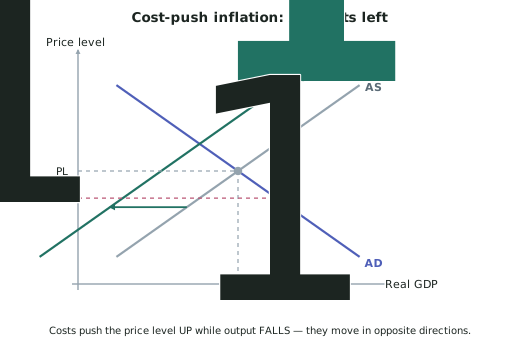
- On the model, AS shifts left, and the price level rises while real GDP falls.
- It is the more damaging kind of inflation, because prices and output move in opposite directions: households face higher prices and a weaker economy at the same time.
The causes
Higher wage costs
- Wages are usually the largest single cost for New Zealand firms.
- Minimum wage rises, successful pay negotiations or a shortage of skilled workers all raise the wage bill.
Higher imported input costs
- New Zealand imports fuel, machinery, fertiliser, electronics and raw materials.
- A rise in world prices for these, or a depreciation of the NZ$, makes every imported input dearer.
Higher fuel and freight costs
- Fuel affects almost every firm, because almost everything is transported. A fuel price rise pushes up costs across the whole economy at once.
Natural disasters and adverse weather
- A cyclone or drought destroys crops and infrastructure, raises insurance and repair costs, and lengthens supply routes.
- These raise costs and reduce productive capacity, so the AS shift is larger and lasts longer.
Taxes and charges on business inputs
- A new levy, an emissions charge or higher compliance costs all add to the cost of producing each unit.
Why the price level rises and output falls
- Higher costs mean firms are less willing to supply at any given price level — so the whole AS curve moves left.
- Firms pass costs on to protect their margins, which raises prices.
- At the higher prices, households buy less, and firms facing higher costs find some production no longer worth doing, so output falls.
- Falling output means firms need fewer workers, so cost-push inflation tends to raise unemployment as well.
The wage–price spiral
- Cost-push inflation can feed itself:
- Costs rise → firms raise prices.
- Workers see prices rising and their real wages falling, so they negotiate higher nominal wages.
- Higher wages are a cost, so AS shifts left again → prices rise again.
- This is the wage–price spiral, and it is why the RBNZ pays attention to inflation expectations: once people expect inflation, they act in ways that produce it.
Comparing the two causes
| Demand-pull | Cost-push | |
|---|---|---|
| Curve that moves | AD right | AS left |
| Price level | Rises | Rises |
| Real GDP | Rises | Falls |
| Employment | Rises | Falls |
| Trigger | More spending | Higher production costs |
| Which is worse | — | Cost-push, because growth falls too |
Worked ExampleA cyclone and its aftermath
A severe cyclone damages roads, bridges and farmland across several New Zealand regions. Production and insurance costs rise for businesses nationwide.
Explain the impact of the cyclone on New Zealand's inflation rate and on real GDP. Refer to the AS/AD model in your answer.
Step 1 — Identify what has changed
Three things rise for firms:
- Repair and rebuilding costs for damaged premises and equipment
- Insurance premiums, which rise for everyone after a large event
- Transport costs, because damaged roads mean longer routes and slower freight
And one thing falls: productive capacity, because farmland and infrastructure have been destroyed.
All of these are about the cost and capacity of producing, not about spending. So this is an AS event.
Step 2 — Shift the curve
Firms can supply less at every price level, so AS shifts left, from AS to AS1. AD is unchanged.
Step 3 — Read the new equilibrium
AS1 cuts the unchanged AD curve higher and further left:
- Price level rises from PL to PL1 — this is the inflation
- Real GDP falls from Y to Y1 — this is the lost output
Step 4 — Explain the chain in words
Cyclone → higher production, insurance and freight costs and lost productive capacity → firms supply less at every price level → AS shifts left to AS1 → the new intersection with AD is at a higher price level PL1 and lower real GDP Y1.
Step 5 — Add the consequence the question is really after
This is cost-push inflation. Unlike demand-pull inflation, it comes with falling output, so unemployment rises at the same time as prices. Because food is heavily damaged and food carries a large weight in the CPI, the measured inflation rate rises by more than the size of the shock to total output alone would suggest.