The business cycle
What the business cycle shows
- The business cycle is the pattern of fluctuations in real GDP growth around the economy's long-run trend.
- It is drawn as a wave: the vertical axis is the percentage change in real GDP, the horizontal axis is time, and the wave oscillates about a zero line.
- Economies do not grow smoothly. They speed up, slow down, shrink and recover, over and over.
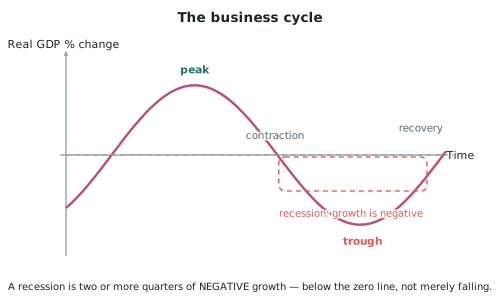
The four phases
Peak (boom)
- Growth is at its highest. The economy is running close to full capacity.
- Unemployment is low, confidence is high, spending is strong.
- Inflationary pressure is at its greatest: AD is high against a capacity-limited AS, and is high.
Contraction (downturn)
- Growth is slowing. Firms see weaker sales, cut hours and delay investment.
- Confidence falls; households save more.
Trough
- The lowest point. Real GDP is at its smallest for the cycle.
- Unemployment is high, spare capacity is large.
- Inflation is at its lowest, and deflation is a risk.
Recovery (expansion)
- Growth is rising again. Firms rehire, confidence returns, investment picks up.
- Spare capacity is absorbed, so at first output rises with little price pressure.
Recession — the precise meaning
- A recession is two or more consecutive quarters of negative real GDP growth.
- On the diagram it is the section below the zero line — output is actually shrinking, not merely growing more slowly.
- Slowing growth is not a recession. A fall from 4% growth to 1% growth is still growth.
Where the cycle sits in an inflation answer
| Phase | AD position | Inflation pressure | |
|---|---|---|---|
| Peak | High, near capacity | High | Strongest |
| Contraction | Falling | Falling | Easing |
| Trough | Low, much spare capacity | Low | Weakest — deflation risk |
| Recovery | Rising | Rising | Building again |
- This is the link the exam wants: the business cycle explains why and move, which then feeds into MV = PQ, and it explains where AD sits relative to capacity, which feeds into the AS/AD model.
Why the phase matters for the size of the price effect
- Near the trough there is plenty of spare capacity, so extra spending mostly raises output () rather than prices (). AD shifts right along a relatively flat stretch of AS.
- Near the peak there is little spare capacity, so extra spending mostly raises prices rather than output. The same rightward AD shift produces a much larger rise in PL.
- The same event has a different inflationary effect depending on where the economy is in the cycle. This is a strong Excellence point in any "which had the bigger impact" question.
Worked ExampleLinking the cycle to inflation
An economy has been at the peak of its business cycle for two years. Forecasters now expect a contraction, with real GDP falling for the next three quarters.
(a) Explain what happens to the velocity of circulation during the contraction. (b) Explain why the same increase in government spending would have a larger effect on the price level at the peak than at the trough.
Step 1 — (a) Velocity during a contraction
As growth slows, households become uncertain about job security and firms become uncertain about future demand.
Both respond by holding money rather than spending it — households build precautionary savings, firms delay investment decisions.
Money that is held is not being passed on, so each dollar changes hands fewer times a year.
Velocity () falls.
Through , a falling reduces total spending , which puts downward pressure on the price level. This is why inflation typically eases through a contraction.
Step 2 — (b) Why the phase changes the size of the price effect
An increase in government spending raises , so AD shifts right in both cases. What differs is how much spare capacity the economy has.
At the trough:
- Unemployment is high and factories, shops and equipment are under-used.
- Firms can meet the extra demand by putting idle resources back to work without bidding up wages or materials much.
- So most of the AD shift becomes extra real GDP () and only a little becomes higher prices ().
At the peak:
- The economy is already close to full capacity. There are few spare workers and little idle equipment.
- Firms trying to expand must bid workers and materials away from each other, which raises costs.
- So most of the AD shift becomes higher prices () and only a little becomes extra output.
The same rightward shift of AD therefore produces a much larger rise in the price level at the peak than at the trough.