Demand-pull inflation
What demand-pull inflation is
- Demand-pull inflation is inflation caused by an increase in aggregate demand — total spending in the economy rising faster than the economy can produce.
- The short version: too much spending chasing too few goods, which pulls prices up.
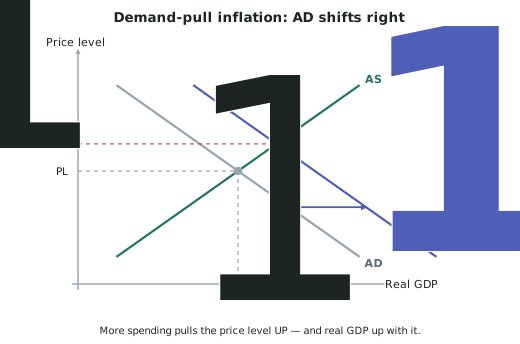
- On the model, AD shifts right, and the price level and real GDP both rise.
The causes — one per component of AD
Consumption () rises
- Lower interest rates — borrowing is cheaper and saving less rewarding, so households borrow and spend more.
- Rising consumer confidence — households expect secure jobs and rising incomes, so they spend rather than save.
- Rising house prices — households feel wealthier and spend more (the wealth effect).
- Tax cuts or transfer payments — households have more disposable income.
Investment () rises
- Lower interest rates — the cost of borrowing to buy machinery, vehicles and buildings falls.
- Rising business confidence — firms expecting strong demand expand capacity.
Government spending () rises
- New infrastructure, health or education spending injects money into the economy.
Net exports () rise
- Higher world prices for New Zealand's exports raise export receipts.
- A depreciation of the NZ$ makes exports cheaper overseas and imports dearer here.
- Strong growth in trading partners raises demand for New Zealand goods.
Why the price level rises
- The economy's productive capacity is limited in the short run — there are only so many workers, machines and materials.
- When spending rises, firms cannot instantly produce everything demanded.
- Shortages appear, and firms respond by raising prices.
- Firms also bid against each other for scarce workers and materials, which raises costs and prices further.
- The closer the economy is to full capacity, the more of the extra spending shows up as higher prices and the less as extra output.
Reading the model correctly
| What happens | On the model |
|---|---|
| Spending rises | AD shifts right to AD1 |
| New equilibrium | Higher up the unchanged AS curve |
| Price level | Rises from PL to PL1 |
| Real GDP | Rises from Y to Y1 |
| Employment | Rises, because more output needs more workers |
- Demand-pull inflation is the less damaging kind: prices rise, but so does output and employment. That is why the exam so often pairs it against cost-push.
Worked ExampleA major event in a region
A large international sporting tournament is held across New Zealand over one summer. Tens of thousands of overseas visitors arrive, and New Zealand households also travel and spend more than usual.
Explain the impact of the tournament on New Zealand's inflation rate. Refer to the AS/AD model in your answer.
Step 1 — Identify the components of AD affected
Two rise at once:
- Consumption () — domestic households spend more on travel, tickets, food and accommodation.
- Net exports () — spending by overseas visitors in New Zealand counts as an export of services (tourism), so export receipts rise.
Step 2 — Shift the curve
Both are components of , so total spending on New Zealand-produced goods and services rises.
AD shifts right, from AD to AD1. AS is unchanged, because the tournament does not change firms' costs of production.
Step 3 — Read the new equilibrium
AD1 cuts AS further up and to the right:
- Price level rises from PL to PL1
- Real GDP rises from Y to Y1
Step 4 — Explain why prices rise rather than just output
Accommodation, hospitality and transport are operating close to capacity for those weeks. A hotel cannot add rooms for one summer. With supply fixed in the short run, the extra demand shows up mostly as higher prices rather than extra output — which is why room rates and airfares spike during major events.