The quantity theory of money
The second model in this standard
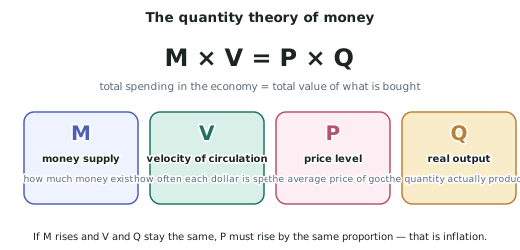
- The quantity theory of money explains inflation in terms of the amount of money in the economy and how fast it is spent.
- It is written as:
- The left side is total spending in the economy. The right side is the total value of everything bought. They must be equal, because every dollar spent is a dollar received.
The four variables — learn these by name
— the money supply
- The total amount of money in the economy: notes, coins and deposits.
- Controlled largely by the central bank and the banking system.
— the velocity of circulation
- The average number of times each dollar is spent in a year.
- It measures how fast money moves, not how much there is.
- rises when people spend confidently and quickly; it falls when people are uncertain and hold on to their money.
— the price level
- The average price of goods and services — the same as on the AS/AD model.
— real output
- The quantity of goods and services actually produced — the same as real GDP.
How to use it to explain inflation
- The equation must always balance. So if one side rises, the other must rise too.
- The standard assumption at Level 2: hold two variables constant and see what must happen to the rest.
| If… | …and these are constant | Then |
|---|---|---|
| rises 5% | and | rises 5% |
| rises 3% | and | rises 3% |
| falls 2% | and | falls 2% |
| rises 6%, rises 6% | unchanged |
- The key insight: inflation happens when total spending () grows faster than real output (). If the extra money buys extra goods, prices need not rise at all.
The role of real output
- If rises and rises by the same proportion, there is more money and more to buy, so does not change.
- If rises while is fixed — because the economy is at capacity — the whole increase must show up in . This is the same idea as an AD shift when the economy is near full capacity.
- If falls while is unchanged, must rise. Less to buy, same spending.
Velocity and the business cycle
- is not fixed, and the exam has tested this directly.
- In a recession, households and firms are uncertain about jobs and demand. They delay purchases and hold money, so each dollar changes hands less often and falls.
- A falling reduces total spending , which puts downward pressure on — one reason inflation typically falls during a downturn.
- In a boom, confidence is high, money moves quickly, rises and inflationary pressure builds.
Worked ExampleWorking with MV = PQ
Assume the velocity of circulation and real output remain constant.
(a) The money supply increases by 6%. Explain the effect on the price level.
(b) In the following year, the money supply increases by 5% and real output also increases by 5%. Explain the effect on the price level.
(c) The economy then enters a recession, and the velocity of circulation falls. Explain the effect on inflation.
Step 1 — (a) Start from the equation
and are constant, so the right-hand side can only change through , and the left-hand side can only change through .
If rises by 6%, then rises by 6%, so must rise by 6%. Since is unchanged:
There is 6% more money chasing the same quantity of goods and services, so each good is bid up in price by 6%.
Step 2 — (b) Now let change too
rises 5%, so rises 5%. rises 5%, so on the right-hand side is 5% larger.
For the equation to balance:
The extra money is matched by extra goods to spend it on, so no bidding up occurs. An increase in the money supply is not inflationary if real output rises with it.
Step 3 — (c) Velocity in a recession
In a recession, households fear job losses and firms fear weak demand, so both delay spending and hold money. Each dollar therefore changes hands fewer times a year: falls.
With unchanged, a fall in reduces total spending . So must fall as well.
Some of that fall shows up as lower — a recession is by definition falling real output. The rest shows up as downward pressure on , so the inflation rate falls.