Answering the Excellence question: which had the bigger impact?
The question that decides your grade
- Every AS91222 paper ends at least one question with a part like:
- "Discuss whether X or Y is likely to have had the more significant impact on New Zealand's current inflation rate."
- "Explain whether X or Y will have a bigger effect on the price level."
- "Compare and contrast the impact of ... on [group A] and [group B]."
- The standard's Excellence criteria are met by exactly this: analysing causes "by comparing and/or contrasting their impact", and "analysis by integrating changes shown on economic models into detailed explanations".
- There is no other route to Excellence in this standard. Learn the shape of this answer.
The five-part structure
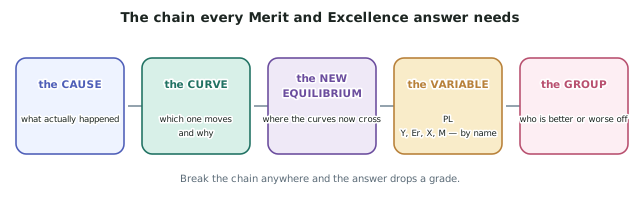
1. Analyse event X fully.
- Name the component or cost that changes.
- Name the curve, the direction and the new labels — AD → AD1, or AS → AS1.
- Read both PL1 and Y1 off the model.
2. Analyse event Y fully.
- The same, in the same order. Do not abbreviate the second one.
3. Compare.
- What is the same about the two effects? Usually both raise the price level.
4. Contrast.
- What is different? If one is an AD shift and one is an AS shift, they move real GDP in opposite directions — say so.
5. Judge, with reasons.
- Choose one. Say which is larger and why, using at least two of the criteria below.
The criteria that justify a judgement
These are the reasons markers reward. Use two or three, not one.
| Criterion | The argument |
|---|---|
| Size of the shift | Which event affects a larger share of total spending or total costs? Consumption is the biggest component of AD; wages are the biggest cost for most firms. |
| How long it lasts | A one-off payment fades; a permanent wage rise or a destroyed factory does not. Persistent shifts move annual inflation more. |
| How broad it is | An event that touches every firm (fuel, wages, freight) shifts AS further than one confined to a single industry. |
| CPI weighting | A price change in a heavily weighted category (housing, food) moves measured inflation far more than one in a lightly weighted category. |
| Where the economy is in the cycle | The same AD shift is far more inflationary at the peak than at the trough, because of spare capacity. |
| Leakages | Spending that goes on imports or into savings does not raise domestic AD by the full amount. |
| Second-round effects | A wage rise can trigger a wage–price spiral; falling confidence can cut as well as . Events with feedback loops are larger than they first appear. |
Words that signal each part
- Compare: both, similarly, in each case, like
- Contrast: whereas, however, by contrast, unlike
- Judge: the larger effect is likely to be, this is because, therefore, on balance
What not to do
- Do not describe both events and stop. Two descriptions side by side is a Merit answer, not an Excellence one.
- Do not judge without reasons. "X is bigger" earns nothing.
- Do not contradict your own graph. If you drew AS shifting left, your words must say the price level rose and output fell.
- Do not copy the resource material. The 2025 report is explicit: "Simply repeating the information contained in the resource material is not sufficient to demonstrate achievement."
Worked ExampleA full Excellence answer, annotated
In one year, the New Zealand government makes a one-off cost-of-living payment to households, and in the same year wage costs across the economy rise sharply.
Discuss whether the cost-of-living payment or the rise in wage costs is likely to have had the larger impact on New Zealand's inflation rate. Refer to the AS/AD model in your answer.
Step 1 — Analyse the cost-of-living payment
The payment raises households' disposable income. Because it is targeted at households with a high propensity to spend, most of it is spent rather than saved, so consumption () rises.
is a component of , so AD shifts right, from AD to AD1. AS is unchanged, because nothing has happened to firms' costs.
At the new intersection with AS: the price level rises from PL to PL1 and real GDP rises from Y to Y1. This is demand-pull inflation.
Step 2 — Analyse the rise in wage costs
Wages are the largest single cost of production for most New Zealand firms. Higher wages mean firms are willing to supply less at every price level.
AS shifts left, from AS to AS1. AD is unchanged.
At the new intersection with AD: the price level rises from PL to PL1 and real GDP falls from Y to Y1. This is cost-push inflation.
Step 3 — Compare
Both events raise the price level. On inflation alone they reinforce each other, so the combined effect on the inflation rate is larger than either alone.
Step 4 — Contrast
They move real GDP in opposite directions. The payment raises output; the wage rise reduces it. So while the effect on inflation is unambiguously upward, the effect on growth is ambiguous and depends on which shift is larger.
They also work through different curves — one on the demand side, one on the supply side — which is why the effects on output offset while the effects on prices do not.
Step 5 — Judge, with reasons
The rise in wage costs is likely to have had the larger impact on the inflation rate.
Reason 1 — persistence. The payment is explicitly one-off. It produces a single burst of spending, after which AD returns close to where it was, so the effect on the annual inflation rate is temporary. A wage rise is built into the cost base permanently; wages very rarely fall. AS1 therefore stays left, and the price level stays higher.
Reason 2 — breadth. Wages are paid by every firm in every industry. A general rise in wage costs raises the price of almost everything in the CPI basket at once. The payment, by contrast, is spent disproportionately on a narrower range of essentials.
Reason 3 — leakages. Part of the payment is saved and part is spent on imports, neither of which raises demand for New Zealand-produced output. So the rightward shift of AD is smaller than the headline value of the payment suggests. Wage costs have no equivalent leakage — every dollar of extra wage cost is a dollar added to the cost of producing in New Zealand.
Reason 4 — the second round. Higher wages can trigger a wage–price spiral: firms raise prices, workers see real wages falling and negotiate again, and AS shifts left a second time. The payment has no such feedback loop.
Conclusion. Both raise the price level, but the wage rise shifts AS left further, more broadly and more permanently than the payment shifts AD right — and it is the only one of the two that also reduces real GDP, meaning New Zealand gets the inflation without the growth.