Impacts of inflation on households and workers
What the standard asks for
- Achieved requires "an explanation of the impacts of changes in inflation on various groups in New Zealand society".
- Excellence requires you to compare and/or contrast the impact on different groups.
- So this is not a list to recite. It is a set of pairs to compare.
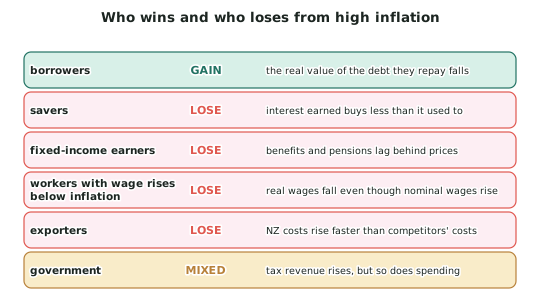
Low-income households
- Hit hardest, for three separate reasons:
- They spend a larger proportion of their income on essentials — food, rent, power, transport — which are the items whose prices tend to rise fastest and which cannot be avoided.
- They have little or no savings buffer to absorb a temporary price shock.
- They have less ability to substitute. A household already buying the cheapest bread cannot trade down.
- Because inflation costs low-income households a larger share of their income than high-income households, inflation makes income distribution more unequal.
High-income households
- Also worse off in absolute terms, but less severely:
- Essentials are a smaller proportion of their spending, so a food or rent rise hurts less as a share of income.
- They can postpone discretionary spending — a holiday, a new car — without hardship.
- They are more likely to hold assets (property, shares) whose value may rise with inflation, offsetting some of the loss.
Workers
- The key concept is the real wage — nominal pay adjusted for inflation.
- Real wages fall whenever inflation exceeds nominal wage growth.
- Workers on the minimum wage are particularly exposed: their pay is reviewed once a year, while prices rise continuously, so their real wage falls between reviews.
- Workers with strong bargaining power — in skill-short industries, or covered by collective agreements with inflation-linked clauses — are better protected.
- Workers responding to falling real wages by demanding higher nominal wages can trigger the wage–price spiral, which pushes AS left and raises prices further.
People on fixed incomes
- Superannuitants and beneficiaries receive payments set in dollars.
- New Zealand Superannuation and main benefits are indexed — adjusted annually in line with price or wage movements — but the adjustment is backward-looking, so recipients lose purchasing power in the gap between adjustments.
- Anyone whose income genuinely does not adjust, such as someone on a fixed private annuity, loses purchasing power continuously.
Comparing groups — the Excellence move
- The exam does not ask "how does inflation affect households". It asks you to compare and contrast two named groups.
- A comparison needs both of these:
- A similarity — usually that both are worse off, because purchasing power falls for everyone.
- A difference — why one is worse off than the other, expressed as a mechanism, not an assertion.
| Pair | The similarity | The difference |
|---|---|---|
| Low vs high income | Both face higher prices | Essentials are a bigger share of the low-income budget, and there is no savings buffer |
| Minimum-wage worker vs skilled worker | Both see real wages squeezed | The skilled worker can bargain; the minimum wage is reset once a year |
| Worker vs superannuitant | Both lose purchasing power | The worker can seek a pay rise or more hours; the superannuitant must wait for indexation |
Worked ExampleComparing two groups
New Zealand's annual inflation rate is 6.1%.
Compare and contrast the impact of this inflation rate on: (i) a household earning $55,000 a year, renting, with no savings (ii) a household earning $180,000 a year, owning its home with a fixed-rate mortgage and $40,000 in a savings account.
Step 1 — Establish what is true for both
Both households face the same 6.1% rise in the general price level, so the purchasing power of both incomes has fallen. Neither is better off.
Step 2 — Household (i): why the effect is larger
Proportion of income on essentials. On $55,000, rent, food, power and transport take up most of the budget. Those are the categories with the largest weights in the CPI and the ones that cannot be avoided, so almost the whole of the 6.1% lands on spending this household must make.
No buffer. With no savings, there is nothing to draw down. A price rise must be met by cutting consumption now.
Rent adjusts. As a renter, this household's largest single cost can be raised by the landlord in line with market conditions, so its housing cost rises with inflation.
No substitution room. A household already buying the cheapest options cannot trade down further.
Step 3 — Household (ii): why the effect is smaller
Proportion of income on essentials. On $180,000, essentials are a much smaller share of spending. A larger share goes on discretionary items that can be postponed at no real cost.
Housing cost is fixed. A fixed-rate mortgage is a payment set in dollars. As prices rise, that fixed payment takes a smaller share of income each year, so the real value of the debt falls — this household actually gains on its mortgage.
Savings are the offsetting loss. The $40,000 loses real value: if the account pays 4%, the real interest rate is about $4% - 6.1% = -2.1%$, so those savings buy less than before.
Step 4 — Bring it together as a comparison
Both households are worse off overall, but for different reasons and by different amounts.
Household (i) loses on every front — its essentials are dearer, its rent can rise, and it has no assets or buffer.
Household (ii) faces offsetting effects: it loses on savings, but gains on the eroded real value of its fixed mortgage, and it can absorb the rest by postponing discretionary spending.
The net effect is far more severe for household (i), which is why inflation widens income inequality in New Zealand.