Measuring inflation: the Consumers Price Index
How New Zealand measures inflation
- Inflation in New Zealand is measured by Stats NZ using the Consumers Price Index (CPI).
- The CPI tracks the price of a fixed basket of goods and services that a typical New Zealand household buys, and reports how much that basket's total cost has changed.
- It is published quarterly (March, June, September and December quarters).
- The inflation rate is the percentage change in the CPI, usually over the year.
How the CPI is built — the four steps
Step 1 — Survey what households actually buy.
- Stats NZ runs the Household Economic Survey to find out how households spend their money.
- This produces the basket: hundreds of representative goods and services, grouped into categories such as housing and household utilities, food, transport, and recreation.
Step 2 — Give each item a weight.
- A weight is the share of total household spending that goes on that item.
- Housing and household utilities take a large share of spending, so they carry a large weight. Recreation takes a smaller share and carries a smaller weight.
Step 3 — Collect prices.
- Prices for every item in the basket are collected regularly from shops, websites and providers across the country.
Step 4 — Calculate the index.
- The basket's cost is expressed as an index number relative to a base period, which is set to 1000.
- An index of 1085 means the basket costs 8.5% more than it did in the base period.
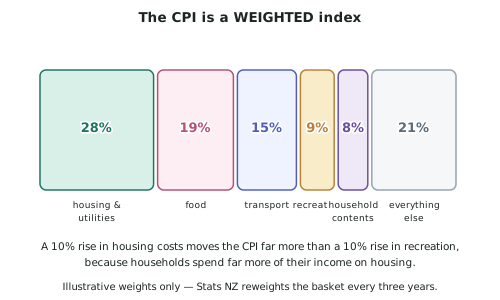
Why the CPI is a weighted index
- Weighted means each item's price change counts in proportion to how much households actually spend on it — not equally.
- A 10% rise in rent moves the CPI far more than a 10% rise in the price of cinema tickets, because households spend far more on rent.
- Without weights the index would be misleading: a huge percentage jump in a trivial item would move the "average" as much as a small rise in the biggest item in the household budget.
- Weights are reviewed and updated by Stats NZ (every three years) so the basket keeps matching real spending patterns as they change.
What the CPI does not capture
- Not everything a household pays for. The CPI covers household consumption; it does not include the price of existing houses or investment assets such as shares.
- Not every household. It is an average basket. A household whose spending is unusual — a big commuter, a family renting in Auckland — can face an inflation rate well above or below the headline number.
- Quality changes. If a laptop costs the same but is twice as fast, the price is unchanged but the household gets more. Adjusting for this is difficult.
- New products take time to enter the basket.
Worked ExampleReading the inflation rate off an index
A country's CPI (base period = 1000) is:
| Quarter | CPI |
|---|---|
| December Year 1 | 1240 |
| December Year 2 | 1302 |
Calculate the annual inflation rate for the year to December Year 2, and state what has happened to prices since the base period.
Step 1 — Write down the formula
The inflation rate is the percentage change in the index:
Step 2 — Substitute
Step 3 — Work the arithmetic
Step 4 — Compare with the base period
The base period is 1000. The index is now 1302, so the basket costs
more than in the base period.