Refraction at a plane boundary
What refraction is
- Refraction is the change of direction of a wave when it crosses into a medium where it travels at a different speed.
- The direction change happens only at the boundary; inside each medium the wave travels in a straight line.
- Refraction happens to all waves — water waves entering shallow water, light entering glass, sound entering warm air.
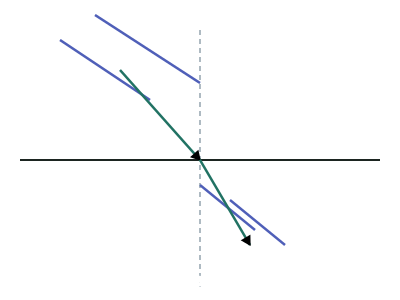
Why the direction changes
-
Consider a set of wavefronts arriving at an angle.
-
One end of each wavefront reaches the slow medium first and slows down, while the other end is still travelling at the original speed.
-
The wavefront therefore pivots — like a car whose left wheels hit sand while the right wheels are still on tarmac.
-
Since rays are perpendicular to wavefronts, the ray direction turns as well.
-
Entering a slower medium: the wave bends toward the normal.
-
Entering a faster medium: the wave bends away from the normal.
-
Along the normal (): the wave slows or speeds up but does not change direction — both ends of the wavefront cross the boundary at the same instant, so there is nothing to pivot.
What happens to each wave quantity
| Quantity | Entering a slower medium |
|---|---|
| Speed | decreases |
| Wavelength | decreases in the same proportion |
| Frequency | unchanged |
| Direction | bends toward the normal |
| Amplitude | usually decreases a little (energy is also reflected) |
- The relationships on the resource sheet tie the ratios together:
- — refractive indices of the two media
- — wave speeds in each medium
- — wavelengths in each medium
- Note the order: pairs with and . A larger refractive index goes with a smaller speed and a shorter wavelength.
Reading a wavefront diagram
- Closer wavefronts = shorter wavelength = slower medium.
- Wider wavefronts = longer wavelength = faster medium.
- The wavefronts must stay continuous across the boundary — they cannot break or double up, because the frequency is the same on both sides.
- Count the wavefronts in a given distance on each side if you are asked to compare wavelengths.
Water waves over a shallow region
- Water waves travel more slowly in shallow water.
- A ramp or submerged shelf therefore refracts them:
- entering the shallow region at an angle, they bend toward the normal,
- their wavelength shortens — visible as the wavefronts crowding together,
- their frequency stays the same.
- This is why waves at a beach line up nearly parallel to the shore no matter which direction they came from: the end of each wavefront that reaches shallow water first slows, and the wave pivots round.
Worked ExampleWater waves entering shallow water
Water waves travelling at m s−1 with a wavelength of m cross into a shallow region where their wavelength becomes m. Find (a) the frequency, (b) the speed in the shallow water, and (c) state how the direction changes if they enter at an angle.
(a) Frequency, from the deep-water values
(b) Speed in the shallow water
The frequency is unchanged at Hz, so:
(c) Direction
The waves have slowed, so they bend toward the normal.