Diffraction through a slit
What diffraction is
- Diffraction is the spreading out of a wave as it passes through a gap or around an obstacle.
- The wave bends into the geometric shadow — the region it could not reach if it travelled only in straight lines.
- Diffraction happens to every wave, and it changes no wave quantity:
- speed unchanged, frequency unchanged, wavelength unchanged,
- only the shape of the wavefronts and the direction of spreading change.
- The amplitude does fall, because the same energy is spread over a wider region.
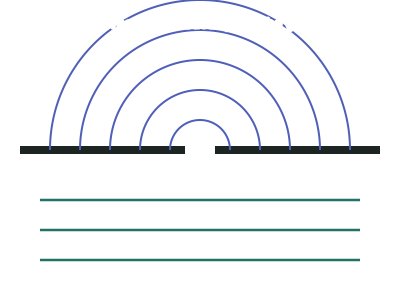
How much a wave spreads
The amount of diffraction depends on the size of the gap compared with the wavelength:
-
Gap much wider than the wavelength — very little spreading. The wave passes through as a beam with only slight fraying at the edges.
-
Gap comparable to the wavelength — strong spreading; the wavefronts emerge as near-semicircles.
-
Gap much narrower than the wavelength — the gap acts almost like a new point source, radiating semicircular wavefronts.
-
Two ways to increase the diffraction, and exam questions use both:
- make the gap narrower,
- use a longer wavelength (which for a given medium means a lower frequency).
-
The single sentence to remember: maximum diffraction occurs when the gap width is about equal to the wavelength.
Diffraction around an obstacle
- The same rule applies to an obstacle: the wave bends around it and fills in the shadow behind.
- Long wavelengths bend around obstacles far more effectively than short ones.
Why you notice it with some waves and not others
- Sound has wavelengths of roughly m to m — comparable to doorways, walls and furniture — so it diffracts strongly. You can hear someone around a corner.
- Light has wavelengths of about m — millions of times smaller than a doorway — so it diffracts far too little to notice, and you cannot see around the corner.
- It is not that light does not diffract. Send light through a slit only a fraction of a millimetre wide and the spreading is obvious.
- Radio waves used for AM broadcasting have wavelengths of hundreds of metres, so they diffract over hills and reach valleys. Higher-frequency signals (FM, mobile phone, TV) have much shorter wavelengths, diffract less, and need line of sight or a local transmitter.
Worked ExampleComparing diffraction of two waves at the same gap
Sound of frequency Hz (speed m s−1) and red light of wavelength nm both pass through a doorway m wide. Compare how much each diffracts.
Step 1 — Wavelength of the sound
Step 2 — Compare each wavelength with the gap
- Sound: m against a gap of m. The wavelength is larger than the gap, so the sound diffracts strongly and spreads out through nearly the full semicircle beyond the doorway.
- Light: m against a gap of m. The gap is over a million times wider than the wavelength, so the light diffracts negligibly and travels on essentially as a straight beam.
Step 3 — The observable consequence
You can hear someone talking through an open doorway from off to one side, but you cannot see them until you are in the direct line of sight.