Describing a wave: amplitude, wavelength, frequency and period
What a wave is
- A wave is a disturbance that transfers energy from one place to another without transferring matter.
- The particles of the medium oscillate about a fixed position — they do not travel along with the wave.
- A duck on the sea bobs up and down as waves pass; it is not carried to the beach.
- Waves need a source that vibrates, and most need a medium to travel through.
Transverse and longitudinal waves
- Transverse — the particles vibrate at right angles to the direction the wave travels.
- Examples: water waves, waves on a rope or spring, light and all electromagnetic waves.
- They have crests (highest points) and troughs (lowest points).
- Longitudinal — the particles vibrate along the direction the wave travels.
- Example: sound (not assessed in this standard, but useful for the contrast).
- They have compressions (particles bunched together) and rarefactions (particles spread apart).
Drag the controls below to compare the two types — watch how the particles move relative to the direction of travel:
At fixed speed, raising f shortens λ ≈ 1.25 m — that is v = fλ.
Drag across to scrub.
The four quantities that describe a wave
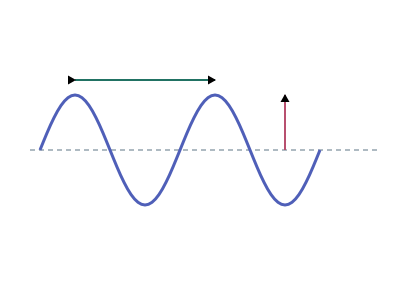
Amplitude () — the maximum distance a particle moves from its rest position.
- Measured in metres (m).
- Measured from the middle to a crest, not from trough to crest.
- Bigger amplitude means the wave carries more energy.
Wavelength (, "lambda") — the length of one complete wave.
- Measured in metres (m).
- Measure it from any point to the identical point on the next wave: crest to crest, trough to trough, or between two points in step.
Frequency () — the number of complete waves passing a point each second.
- Measured in hertz (Hz), where Hz one wave per second.
- It is set by the source of the wave and never changes when a wave moves into a new material.
Period () — the time for one complete wave to pass a point.
-
Measured in seconds (s).
-
Frequency and period are reciprocals of each other:
- A wave with a period of s has a frequency of Hz — four waves every second.
Wavefronts and rays
Two ways of drawing the same wave, and exam questions use both:
- A wavefront is a line joining points that are in phase — usually drawn along the crests.
- Adjacent wavefronts are one wavelength apart, so the spacing of the lines is the wavelength.
- Closer wavefronts mean a shorter wavelength.
- A ray is an arrow showing the direction the wave travels.
- Rays are always drawn at right angles to the wavefronts.
- Use wavefronts when a question asks about wavelength or speed changing; use rays when it asks about angles and direction.
In phase and out of phase
- Two points are in phase when they are doing exactly the same thing at the same moment — both at a crest, or both moving upward through the middle.
- Points one wavelength apart (or any whole number of wavelengths) are in phase.
- Two points are out of phase when they are doing opposite things — one at a crest while the other is at a trough.
- Points half a wavelength apart are completely out of phase.
Worked ExampleReading a wave diagram
A transverse wave is drawn on axes of displacement against distance. The curve reaches m at its crests and m at its troughs, and successive crests are m apart. Four complete waves pass a fixed point every second. Find the amplitude, wavelength, frequency and period.
Step 1 — Amplitude
Measure from the rest position (the axis) to a crest, not trough to crest:
Step 2 — Wavelength
Crest to crest is one complete wave:
Step 3 — Frequency
Four complete waves per second:
Step 4 — Period