Total internal reflection and the critical angle
Key ideas
When light travels from a denser material toward a less dense one (e.g. glass → air), it bends away from the normal. Increase the angle of incidence enough and the refracted ray bends until it runs along the surface — at the critical angle , the angle of refraction is .
Beyond the critical angle, no light escapes — it is all reflected back inside. This is total internal reflection (TIR).
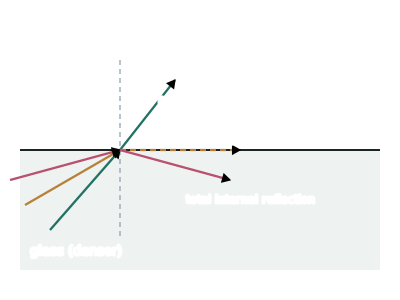
The two conditions for TIR
TIR happens only when both are true:
- Light is going from a more dense to a less dense medium ().
- The angle of incidence is greater than the critical angle ().
Finding the critical angle
At the critical angle, , so Snell's law becomes:
Since :
- — refractive index of the denser medium (where the light starts)
- — refractive index of the less dense medium
:::tip TIR only works "denser to less dense". If a question sends light from air into glass, the critical angle idea does not apply — light always refracts into the denser medium. Check the direction before reaching for . :::
Glass has a refractive index of . Find the critical angle for light passing from this glass into air ().
Step 1 — Apply the critical-angle relationship
Step 2 — Take the inverse sine
Practice question
Water has a refractive index of . Find the critical angle for a water–air boundary.
Worked solution: , so .
Test yourself
Practice by grade
One question each at Achieved, Merit and Excellence. Have a go, then compare with the model answer.
A type of glass has refractive index .
Calculate the critical angle for light passing from this glass into air ().
The critical angle for a certain plastic–air boundary is .
Calculate the refractive index of the plastic.
Explain fully how total internal reflection allows an optical fibre to carry light along a curved path, referring to the critical angle and the two conditions required.