Refraction of light and Snell's law
Refractive index
- Light travels fastest in a vacuum, at m s−1, and more slowly in every material.
- The refractive index of a material measures how much it slows light down:
-
— refractive index (no units — it is a ratio)
-
— speed of light in a vacuum ( m s−1)
-
— speed of light in the material (m s−1)
-
Because light always slows, is always greater than 1.
-
Typical values worth recognising:
- vacuum: exactly ; air: (treated as ),
- water: ,
- glass: about ,
- diamond: .
-
A larger means a slower speed, a shorter wavelength inside the material, and more bending at the surface. The material is described as optically denser.
- "Optically denser" is not the same as "heavier". It refers only to how much the material slows light.
Snell's law
-
— refractive index of the medium the light starts in
-
— angle of incidence, measured from the normal
-
— refractive index of the medium the light enters
-
— angle of refraction, measured from the normal
-
The equation is symmetrical: light travelling the other way along the same path refracts by the same angles. Light paths are reversible.
-
The direction of bending follows directly:
- entering a denser medium (): , so the ray bends toward the normal,
- entering a less dense medium (): , so the ray bends away from the normal,
- at (along the normal): , so — no bending, though the speed still changes.
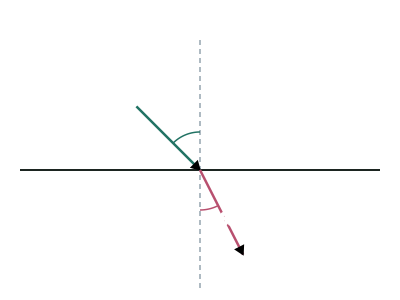
Change the angle of incidence and the refractive index below, and watch the refracted ray respond:
Ray bends toward the normal
Drag the gold dot to change θ₁.
Light through a parallel-sided block
- A ray entering a rectangular glass block bends toward the normal.
- At the far surface it bends away from the normal by exactly the same amount.
- The emerging ray is therefore parallel to the original ray, but displaced sideways.
- The bigger the refractive index or the angle of incidence, the bigger the sideways shift.
Applying Snell's law
- Draw the normal at the surface and label the two angles.
- Identify which medium is 1 (where the light starts) and which is 2.
- Substitute into .
- Rearrange for the unknown, then take if you are solving for an angle.
- Check the direction of bending is consistent with which medium is denser.
Worked ExampleLight entering water
A ray of light travels from air into water () with an angle of incidence of . Find the angle of refraction.
Step 1 — Identify the media
Medium 1 is air: , . Medium 2 is water: ,
Step 2 — Substitute into Snell's law
Step 3 — Solve
Worked ExampleFinding a refractive index from measurements
A student shines light from air into a plastic block. When the angle of incidence is , the angle of refraction is measured as . Find the refractive index of the plastic and the speed of light inside it.
Step 1 — Apply Snell's law with the air side as medium 1
Step 2 — Solve for the refractive index
Step 3 — Speed of light in the plastic