Superposition of pulses
Key ideas
When two pulses (or waves) pass through the same point at the same time, the total displacement is the sum of the individual displacements. This is the principle of superposition.
- Displacements above the line are positive; below the line, negative.
- Add them at every point to get the combined shape.
- After they pass through each other, each pulse carries on unchanged — superposition is only temporary.
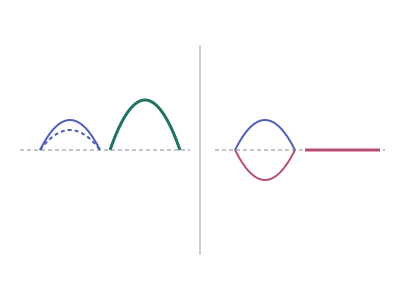
Constructive superposition
- Happens where displacements are in the same direction (both up, or both down).
- The combined displacement is larger than either alone.
- Two crests of and combine to .
Destructive superposition
- Happens where displacements are in opposite directions (one up, one down).
- The combined displacement is smaller, and can be zero if they are equal and opposite.
- A crest of meeting a trough of gives a momentary flat line ().
:::tip Destructive superposition does not destroy the pulses. At the instant they overlap the string can be completely flat, but the energy is still there as motion — a moment later both pulses reappear and continue on their way. Never write that the waves "cancel out permanently." :::
At one point, pulse A gives a displacement of cm and pulse B gives a displacement of cm at the same instant. Find the resultant displacement.
Apply the principle of superposition — add the displacements, keeping their signs:
The resultant is cm — smaller than pulse A alone, because B partly cancels it.
Practice question
Two pulses overlap at a point: one gives cm, the other cm. What is the resultant displacement, and is this constructive or destructive?
Worked solution: cm. Both are in the same direction, so it is constructive superposition.
Test yourself
Practice by grade
One question each at Achieved, Merit and Excellence. Have a go, then compare with the model answer.
At a point, two pulses give displacements of cm and cm at the same instant.
State the principle of superposition and calculate the resultant displacement.
Two identical crests, each of amplitude cm, completely overlap. Then a crest of cm completely overlaps a trough of cm.
Calculate the resultant displacement in each case and name the type of superposition.
Two pulses of equal size and shape but opposite sign travel toward each other on a rope. Explain fully what an observer sees at the instant they fully overlap, and what happens immediately afterwards.