Reflection at a plane boundary
The law of reflection
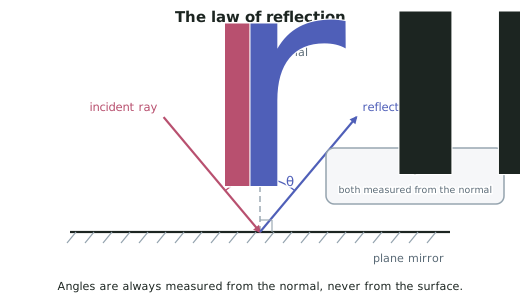
- When a wave meets a plane (flat) boundary it can be reflected — it bounces back into the medium it came from.
-
— the angle of incidence
-
— the angle of reflection
-
Both angles are measured from the normal, not from the surface.
- The normal is the construction line drawn at right angles to the surface at the point where the wave strikes.
- Drawing it, and labelling it "normal", is expected in every ray diagram.
-
The incident ray, the reflected ray and the normal all lie in the same plane.
What does and does not change on reflection
- The wave stays in the same medium, so:
- the speed is unchanged,
- the frequency is unchanged,
- therefore the wavelength is unchanged.
- Only the direction changes.
- On a wavefront diagram, the reflected wavefronts have the same spacing as the incident ones — a useful check on your drawing.
Phase change on reflection
The standard asks about phase changes at a boundary, and there are two cases for a pulse on a rope or spring:
-
Reflection from a fixed end (a denser medium, or a wall):
- the pulse is inverted — a crest comes back as a trough,
- this is a phase change of half a wavelength (often stated as ).
-
Reflection from a free end (a less dense medium, or a loose ring on a pole):
- the pulse comes back the same way up,
- there is no phase change.
-
The memory hook: a fixed end flips the pulse; a free end does not.
-
In both cases the pulse keeps its shape and its width — reflection does not change the wavelength.
Drawing a reflection ray diagram
- Draw the surface and mark the point where the ray strikes it.
- Draw the normal at that point, at to the surface, as a dashed line.
- Measure the angle of incidence from the normal with a protractor.
- Measure the same angle on the other side of the normal and draw the reflected ray.
- Add arrows to both rays showing the direction of travel.
Worked ExampleAngles measured from the surface
A light ray strikes a plane mirror at an angle of to the mirror surface. Find the angle of incidence and the angle of reflection, and the angle between the incident and reflected rays.
Step 1 — Convert to an angle from the normal
The normal is at to the surface, so:
Step 2 — Apply the law of reflection
Step 3 — Angle between the two rays
Both rays sit from the normal, on opposite sides of it: