Projectile motion
Key ideas
A projectile is anything moving freely under gravity alone. The single most important idea:
The horizontal and vertical motions are independent. Horizontally there is no force, so velocity is constant. Vertically, gravity accelerates the object at m s⁻² downward. The only thing the two directions share is time.
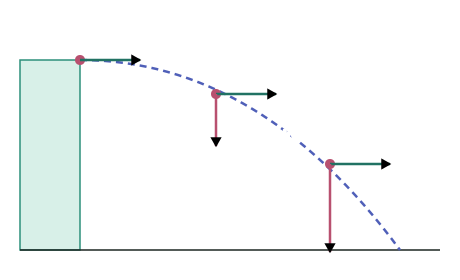
A ball rolls off a cliff horizontally at m s⁻¹. The cliff is m high. Find (a) the time to land, (b) how far from the cliff base it lands, (c) its vertical velocity on landing.
(a) Time — from the vertical motion alone
Vertically the ball starts from rest (), falls m at m s⁻²:
(b) Range — from the horizontal motion alone
No horizontal force, so the speed stays a constant m s⁻¹ for that s:
(c) Vertical landing velocity
For Excellence: the true landing velocity combines both components — m s⁻¹ at about below the horizontal.
Practice question
A stone is thrown horizontally at m s⁻¹ from a bank m above a river. How far out from the bank does it splash down?
Worked solution: fall time from vertical motion: gives s. Horizontal distance m.
Test yourself
Practice by grade
One question each at Achieved, Merit and Excellence. Have a go, then compare with the model answer.
A ball is dropped from a height of m (take m s⁻²).
Calculate the time it takes to reach the ground.
A ball is kicked horizontally at m s⁻¹ from the top of a m high wall.
Calculate how far from the base of the wall the ball lands, and explain why its horizontal velocity does not change during the flight.
One ball is thrown horizontally and another is dropped, both released from the same height at the same instant.
Describe and explain fully, using physics principles, why the two balls hit the ground at the same time.