Equilibrium: balanced forces and torques
Key ideas
A torque (turning effect) is produced when a force acts at a distance from a pivot:
where is the perpendicular distance from the pivot to the line of the force. Torque is measured in newton metres (N m).
An object is in equilibrium when both:
- the forces balance (no acceleration), and
- the torques balance — total clockwise torque = total anticlockwise torque about any pivot (no rotation).
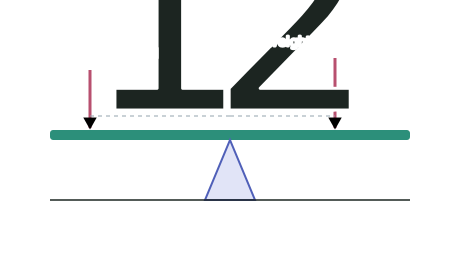
A kg child sits m to the left of a see-saw's pivot. Where must a kg child sit for it to balance?
Step 1 — Anticlockwise torque from the lighter child
Her weight is N, acting m from the pivot:
Step 2 — Set the clockwise torque equal
The heavier child's weight is N at unknown distance :
The heavier child sits closer to the pivot — the same torque from more force needs less distance.
Step 3 — Force check (for completeness)
The pivot pushes up with N, balancing the total downward weight.
Practice question
A m uniform plank is pivoted at its centre. A N toolbox sits m from the pivot. What force applied at the far end ( m from the pivot, other side) balances it?
Worked solution: torque to balance N m; force needed N downward on the other side.
Test yourself
Practice by grade
One question each at Achieved, Merit and Excellence. Have a go, then compare with the model answer.
A N force is applied at the end of a m long spanner, perpendicular to the handle.
Calculate the torque (turning moment) about the bolt.
A uniform plank is balanced on a central pivot. A N weight is placed m to the left of the pivot.
Calculate where a N weight must be placed on the right-hand side for the plank to balance.
A m uniform beam is pivoted at its centre. A N box sits m to the left of the pivot, and a person pushes straight down at the right-hand end, m from the pivot.
Calculate the force the person must apply to balance the beam, and explain why the beam's own weight does not appear in your torque calculation.