Unbalanced force and acceleration (Newton's laws)
Key ideas
- If the forces on an object balance (net force zero), its velocity doesn't change — it stays at rest or keeps moving at constant velocity.
- If the forces are unbalanced, the object accelerates in the direction of the net force:
- Weight is the gravitational force on a mass: , with m s⁻² — straight down.
The tool for every force problem is a free-body diagram: the object, with every force on it drawn as a labelled arrow.
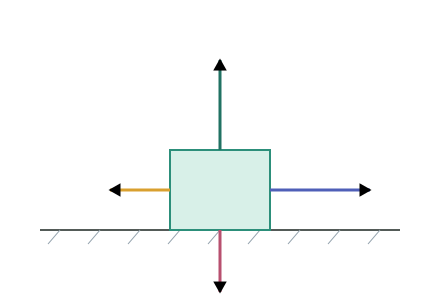
A kg car has a driving force of N and total resistive forces of N. Find its acceleration.
Step 1 — Find the net force
Subtract the backward forces from the forward force:
Step 2 — Apply Newton's second law
The same car later travels at a constant m s⁻¹. What is the driving force now?
Constant velocity means zero acceleration, so by the net force is zero — the driving force exactly balances the N of resistance:
Practice question
A kg runner accelerates at m s⁻². What net force does she experience? What is her weight?
Worked solution: N forward. Weight N downward — note weight acts vertically and doesn't affect the horizontal net force here.
Test yourself
Practice by grade
One question each at Achieved, Merit and Excellence. Have a go, then compare with the model answer.
A kg trolley experiences a net force of N.
Show that its acceleration is m s⁻².
A kg car has a forward driving force of N and experiences N of resistance.
Calculate the car's acceleration, then state what the driving force must be for the car to travel at a constant velocity.
A parachutist falls and eventually reaches a constant velocity (terminal velocity).
Describe and explain fully, using physics principles, why the parachutist's velocity becomes constant.