The circular flow model
What the model shows
- The circular flow model shows how money moves around the economy between the sectors that make it up.
- The inner flow is the core: households supply resources (labour, land, capital, enterprise) to producers and receive income (Y); producers supply goods and services and receive consumption spending (C).
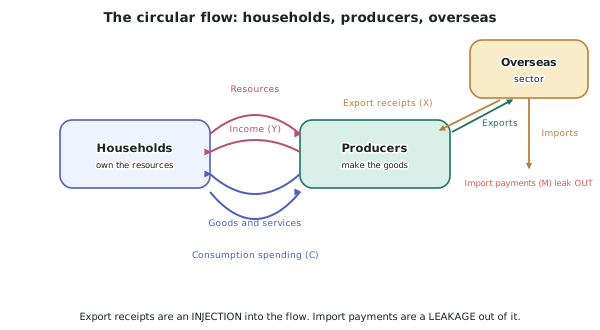
- Because every dollar producers pay out as income comes back as spending, income and output are the same total: this is why real GDP can be measured either way.
Leakages and injections
The full model adds three outside sectors. Each one takes money out of the flow and puts money back in.
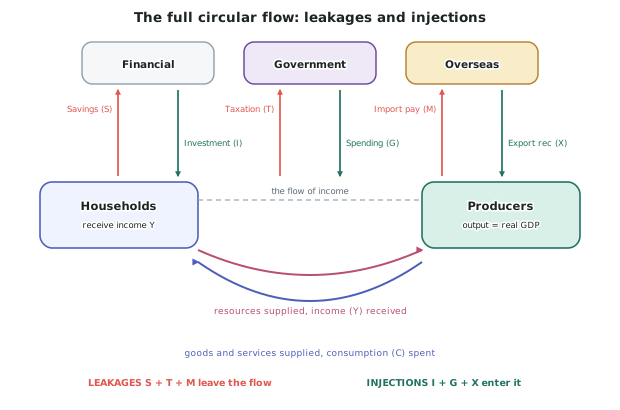
| Sector | Leakage (money out) | Injection (money in) |
|---|---|---|
| Financial | Savings (S) | Investment (I) |
| Government | Taxation (T) | Government spending (G) |
| Overseas | Import payments (M) | Export receipts (X) |
- Leakages = S + T + M. Income that households receive but do not pass on to domestic producers.
- Injections = I + G + X. Spending that reaches domestic producers from outside the household flow.
What the balance tells you
- If injections > leakages, more money enters the flow than leaves it. The flow grows — real GDP rises, and the economy expands.
- If leakages > injections, the flow shrinks — real GDP falls, and the economy contracts.
- If injections = leakages, the flow is in equilibrium and real GDP is stable.
Using the model to trace an external shock
This is exactly what Question One of the paper asks. The method is always the same:
- Identify which flow is hit first. A recession overseas hits export receipts (X).
- Say whether that is a leakage or an injection, and which way it moves. Export receipts are an injection, and they fall.
- State the effect on the flow. Injections fall, so injections are now less than leakages and the circular flow contracts.
- Trace it round. Producers receive less, so they produce less and employ fewer people, so household income falls.
- Trace it round again. Lower household income means lower consumption spending, so producers receive even less. The contraction compounds — this is the multiplier, covered on its own page.
- Name the goal affected. Falling real GDP is the goal of economic growth; rising unemployment is full employment; falling export receipts worsens the current account.
The four words the reports say get confused
- Exports are the goods and services New Zealand sends overseas. Export receipts (X) are the money that comes back for them. Only the money flows in the circular flow diagram.
- Imports are the goods and services New Zealand brings in. Import payments (M) are the money that goes out for them.
- The 2025 report lists "exports / export receipts" and "imports / import payments" among the terms candidates confused. On the model, goods flow one way and money flows the other.
Worked ExampleTracing a fall in export receipts
New Zealand's two largest trading partners both enter a recession, so demand for New Zealand exports falls sharply.
Using the circular flow model, explain how this could negatively affect New Zealand's economy and its goal of a balanced current account.
Step 1 — Identify the flow that is hit
A recession means incomes and spending fall in those countries. Their households and firms buy fewer New Zealand goods and services.
The flow affected is export receipts (X) — the money New Zealand producers receive from overseas buyers.
Step 2 — Name it as an injection and give the direction
Export receipts are an injection into the circular flow.
Because overseas buyers are purchasing less, export receipts fall.
Step 3 — State the effect on the balance of the flow
With X falling while savings, taxation and import payments are unchanged, injections (I + G + X) fall below leakages (S + T + M).
More money is now leaving the circular flow than entering it, so the flow contracts.
Step 4 — Trace it round to producers and households
New Zealand exporting firms — dairy processors, meat companies, tourism operators — receive less revenue. They respond by producing less.
To produce less they need fewer resources, so they reduce hours and lay off workers. That means they pay out less income (Y) to households.
Real GDP falls, so the goal of economic growth is not being met, and unemployment rises, so the goal of full employment is not being met either.
Step 5 — Trace the second round
Households now have less income. Because consumption depends on income, consumption spending (C) falls.
Producers selling to the domestic market — retailers, cafés, tradespeople — now receive less revenue too, even though they never exported anything. They in turn cut output and employment, so household income falls again.
The initial fall in export receipts therefore causes a larger total fall in real GDP than the first-round loss. This compounding is the multiplier.
Step 6 — The effect on the current account
The current account records exports against imports. Export receipts are a credit in the goods and services components.
Because export receipts have fallen while import payments have not changed initially, the current account balance worsens — the deficit widens. The goal of a balanced current account is not being met.
Step 7 — The offsetting second-round effect
There is a partial offset, and saying so lifts the answer. As household income falls, New Zealanders spend less on everything, including imports. So import payments (M) also fall.
Because import payments are a debit in the current account, this partly narrows the deficit again.
The net effect on the current account depends on which falls further — export receipts, driven by the overseas recession, or import payments, driven by lower New Zealand incomes. In a sharp overseas downturn, export receipts usually fall faster, so the current account still worsens overall.