The spending multiplier
What the multiplier is
- The spending multiplier measures how much total real GDP changes as a result of an initial injection into the circular flow.
- The final change is larger than the initial injection, because the money is spent again and again as it circulates.
How it works, round by round
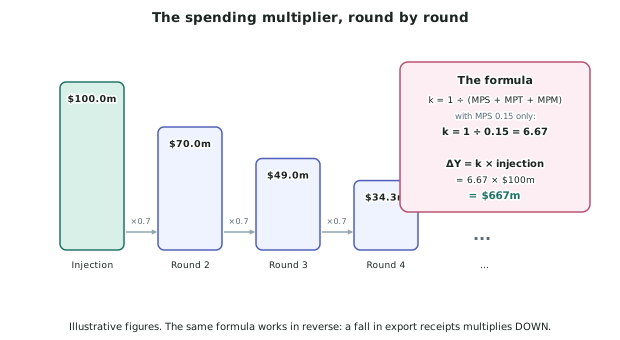
- The government spends $100 million on a hospital. Builders, suppliers and staff receive that as income.
- Those households spend a share of it and leak the rest into savings, tax and imports. If they spend 70%, that is $70 million of new spending.
- The recipients of that $70 million do the same, spending 70% of it — $49 million.
- Each round is smaller than the last, because some money leaks out every time.
- The rounds add up to a finite total that is larger than the original $100 million.
The formula
The multiplier depends on how much leaks out at each round.
k = 1 ÷ MPS — when savings are the only leakage
k = 1 ÷ (MPS + MPT + MPM) — with all three leakages
- MPS — marginal propensity to save: the fraction of each extra dollar of income that is saved.
- MPT — marginal propensity to tax: the fraction paid in tax.
- MPM — marginal propensity to import: the fraction spent on imports.
- MPC — marginal propensity to consume: the fraction spent on domestic goods and services. Since every dollar is either spent domestically or leaks, MPC + MPS + MPT + MPM = 1, so k = 1 ÷ (1 − MPC) as well.
Then:
ΔY = k × initial injection
- ΔY is the final change in real GDP.
Working with it
- The bigger the leakages, the smaller the multiplier. A country that imports a lot has a small multiplier, because a large share of every extra dollar leaves the country immediately.
- The smaller the leakages, the bigger the multiplier.
It works in both directions
- This is examined and it catches people out. The 2025 paper required the multiplier applied to a fall in export receipts, and the report notes candidates who "defined, calculated, and applied the concept of multiplier but did not do the same in a negative context".
- A withdrawal from the circular flow multiplies down by exactly the same factor.
- A $50 million fall in export receipts with k = 4 causes a $200 million fall in real GDP.
- The arithmetic is identical; only the sign changes.
Which injections does it apply to?
- Any injection into the circular flow: investment (I), government spending (G) or export receipts (X).
- Also to withdrawals: a rise in taxation or a fall in export receipts multiplies downwards.
- A tax cut has a smaller multiplier than an equivalent amount of government spending, because households save and import part of the tax cut before the first round of spending even begins. Government spending enters the flow in full at round one.
Worked ExampleCalculating the multiplier in both directions
An illustrative economy has a marginal propensity to save of 0.15. Assume savings are the only leakage.
(a) The government increases spending on health and education by $9.97 billion. Calculate and explain the final effect on real GDP and economic growth.
(b) In the same year, a fall in visitor numbers reduces export receipts by $1.2 billion. Calculate the final change in real GDP.
Part (a), Step 1 — State the formula
The multiplier is:
k = 1 ÷ MPS
Part (a), Step 2 — Substitute and calculate
k = 1 ÷ 0.15
k = 6.67 (to two decimal places)
Part (a), Step 3 — Calculate the final change in real GDP
ΔY = k × initial injection
ΔY = 6.67 × $9.97 billion
ΔY = $66.5 billion (using the unrounded multiplier)
Part (a), Step 4 — Explain why it is so much larger than $9.97 billion
The government's $9.97 billion goes to nurses, teachers, builders and suppliers, who receive it as income.
Because the marginal propensity to save is 0.15, they save 15 cents of every extra dollar and spend the other 85 cents on New Zealand goods and services. That $8.47 billion of spending becomes someone else's income, and those households in turn spend 85% of it.
Each round is smaller than the last, because 15% leaks into savings every time. But the rounds keep going, and they add up to a total of $66.5 billion — about 6.67 times the original injection.
Part (a), Step 5 — Link to the goal
On the circular flow model, government spending (G) is an injection, so injections now exceed leakages and the flow expands.
On the AD/AS model, higher G means AD shifts right to AD1, so real GDP rises — the goal of economic growth is served.
How much of the $66.5 billion appears as real output rather than as a higher price level depends on spare capacity. With a large recessionary gap the economy is on the flat section of AS, so most of it becomes real GDP. Near Yf the steep section means much of it becomes inflation instead.
Part (b), Step 1 — The same multiplier applies
Nothing about the economy's leakages has changed, so k is still 6.67.
Part (b), Step 2 — Apply it to a withdrawal
Export receipts are an injection, and they have fallen, so the change is negative.
ΔY = k × change in injection ΔY = 6.67 × (−$1.2 billion)
ΔY = −$8.0 billion
Part (b), Step 3 — Explain the negative direction
Tourism operators receive $1.2 billion less revenue, so they cut hours and lay off staff. Those households have less income, so they spend 85% less at shops, cafés and tradespeople — who in turn lose revenue and cut their own staff.
The contraction compounds exactly as the expansion did, but downwards. Real GDP falls by $8.0 billion, which is 6.67 times the original loss.
This is why a fall in one export sector affects businesses that have nothing to do with exporting.
Step 4 — The combined effect
Net change in real GDP = +$66.5 billion − $8.0 billion = +$58.5 billion
The government spending more than offsets the fall in export receipts, so real GDP still rises and the goal of economic growth is served overall.