Monetary policy and the OCR
Who runs it and with what
- Monetary policy is run by the Reserve Bank of New Zealand (RBNZ) — not by the government.
- Its instrument is the Official Cash Rate (OCR), set by the RBNZ's Monetary Policy Committee on a published schedule.
- Its objective comes from the Remit issued under the Reserve Bank of New Zealand Act 2021: keep annual CPI inflation between 1% and 3%, focused on the 2% midpoint. The older name Policy Targets Agreement (PTA) still appears in exam material.
The transmission chain
The OCR is the rate at which banks borrow from and lend to the Reserve Bank overnight. Changing it changes all the interest rates in the economy.
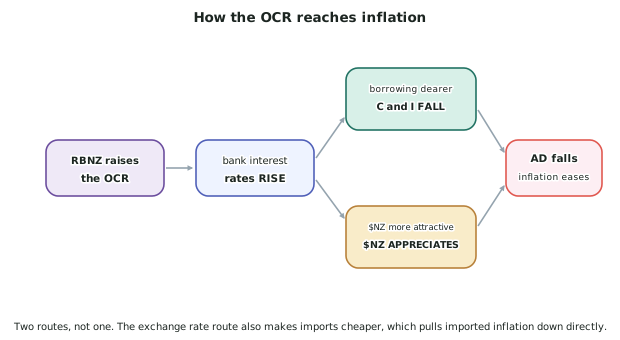
Contractionary monetary policy — raising the OCR
Route 1 — spending
- RBNZ raises the OCR.
- Banks' cost of funds rises, so bank interest rates rise on mortgages, business loans and savings.
- Borrowing becomes more expensive, so households buy fewer consumer durables on credit and delay house purchases — consumption (C) falls. Saving becomes more attractive, reinforcing the fall in C.
- Firms find fewer projects profitable at the higher cost of borrowing — investment (I) falls.
- AD shifts left, so the price level rises more slowly and inflation eases.
Route 2 — the exchange rate
- Higher New Zealand interest rates make New Zealand assets more attractive to overseas investors.
- They must buy $NZ to invest here, so demand for the $NZ rises and the currency appreciates.
- An appreciation makes imports cheaper in New Zealand dollars, which directly reduces imported inflation.
- It also makes New Zealand exports dearer overseas, so export receipts fall, reducing (X − M) and shifting AD further left.
- Both routes point the same way, which is why monetary policy is powerful. Naming both is a Merit-level move.
Expansionary monetary policy
- Lowering the OCR reverses every step: interest rates fall, C and I rise, AD shifts right, and the $NZ depreciates, making exports cheaper and imports dearer.
- Used when the economy has a recessionary gap and inflation is at or below the bottom of the band.
Effectiveness depends on the size of the gap
- This was the 2025 Question Three, and it is the model Excellence question for this topic.
- With a large recessionary gap, the economy is on the flat section of AS with plenty of spare capacity. A rightward AD shift produces a large increase in real GDP and a large fall in unemployment, with only a small rise in the price level. Expansionary monetary policy is highly effective at reducing unemployment.
- With a small recessionary gap, the economy is close to Yf on the steep section of AS. The same rightward AD shift produces little extra real GDP, so unemployment barely falls, while the price level rises sharply. The same policy is far less effective, and it threatens price stability.
Limitations
- Time lags. A change in the OCR takes 12 to 18 months to have its full effect, so the RBNZ must act on a forecast rather than on today's data.
- It is a blunt instrument. The OCR affects the whole economy, and it cannot target one region or one sector.
- It cannot fix a supply shock. If inflation is caused by AS shifting left — an oil price spike — raising the OCR reduces inflation only by further reducing output and employment.
- Households on fixed mortgages are unaffected until they refix, so the effect is uneven and delayed.
Worked ExampleExpansionary monetary policy under two different gaps
New Zealand is in a downturn and the RBNZ lowers the OCR.
(a) Explain how expansionary monetary policy affects interest rates in New Zealand.
(b) Explain the effectiveness of this policy in lowering unemployment when New Zealand has a large recessionary gap compared with a small recessionary gap.
Part (a) — From the OCR to interest rates
The OCR is the rate at which registered banks borrow from and lend to the Reserve Bank of New Zealand overnight. It is therefore the base cost of funds for the whole banking system.
When the RBNZ lowers the OCR, banks can obtain funds more cheaply. Competition between banks passes this on, so retail interest rates fall — on mortgages, personal loans, business lending and savings accounts.
Two consequences follow:
- Borrowing becomes cheaper, so households and firms take on more debt to buy things.
- Saving becomes less rewarding, so households save less and spend more.
Part (b), Step 1 — Trace the policy through AD
Lower interest rates mean:
- Consumption (C) rises — cheaper credit makes cars, appliances and houses more affordable, and lower mortgage payments leave households with more to spend.
- Investment (I) rises — a lower cost of borrowing makes more capital projects profitable, so firms build and buy equipment.
Because AD = C + I + G + (X − M) and both C and I have risen, AD shifts right to AD1.
There is a second route: lower New Zealand interest rates make New Zealand assets less attractive to overseas investors, so demand for the $NZ falls and the currency depreciates. That makes exports cheaper overseas, raising export receipts (X), and imports dearer, reducing import payments (M). Net exports rise, shifting AD further right.
Part (b), Step 2 — The large recessionary gap
With a large recessionary gap, equilibrium real GDP Y is a long way left of Yf. There is a great deal of spare capacity: idle factories, unused equipment, and many unemployed workers looking for jobs.
The economy is therefore on the flat section of the AS curve. Firms can meet the extra demand by putting spare resources back to work without having to bid up wages or input prices.
So the rightward shift from AD to AD1 produces:
- a large increase in real GDP, from Y to a much higher Y1
- only a small rise in the price level
Because firms need many more workers to produce that much more output, employment rises substantially and unemployment falls a long way. The recessionary gap narrows sharply.
Expansionary monetary policy is highly effective at lowering unemployment here, and it does so with little cost to price stability.
Part (b), Step 3 — The small recessionary gap
With a small recessionary gap, equilibrium real GDP Y is already close to Yf. There is little spare capacity — most machinery is running and most workers who want jobs have them.
The economy is on the steep section of the AS curve. Firms wanting to expand must compete for the same scarce workers and materials, bidding wages and input prices up.
So the same rightward shift from AD to AD1 produces:
- only a small increase in real GDP
- a large rise in the price level
Because real GDP barely rises, firms hire only a few extra workers, so unemployment falls only slightly.
Expansionary monetary policy is far less effective at lowering unemployment here, and it now threatens the goal of price stability, potentially pushing inflation above the RBNZ's 1–3% band.
Part (b), Step 4 — The comparison and the conclusion
| Large gap | Small gap | |
|---|---|---|
| Position on AS | Flat section | Steep section |
| Spare capacity | Plentiful | Little |
| Effect on real GDP | Large increase | Small increase |
| Effect on unemployment | Large fall | Small fall |
| Effect on price level | Small rise | Large rise |
| Effectiveness on unemployment | High | Low |
The same policy, applied with the same force, produces very different results — and the variable that decides it is the amount of spare capacity, shown on the model by how far Y sits from Yf and therefore which section of the AS curve the economy is on.
This is why the RBNZ's judgement about where the economy sits relative to Yf matters more than the size of the OCR change itself.