Fiscal, supply side and trade policy
The four policy types
The 2026 Assessment Specification names exactly four. Know who runs each and which curve it shifts.
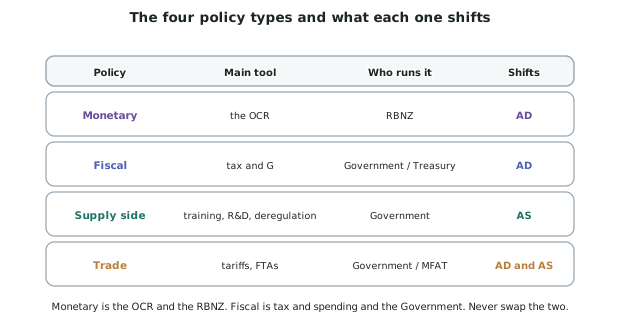
| Policy | Main tool | Who runs it | Shifts |
|---|---|---|---|
| Monetary | The OCR | RBNZ | AD |
| Fiscal | Taxation and government spending | Government / Treasury | AD |
| Supply side | Training, R&D, infrastructure, deregulation | Government | AS |
| International trade | Tariffs, free trade agreements | Government / MFAT | AD and AS |
Fiscal policy
- Fiscal policy is the government's use of taxation and government spending to influence the economy. It is set in the Budget each May, and the Treasury publishes the forecasts in the Budget Economic and Fiscal Update (BEFU) and the Half Year Update (HYEFU).
Expansionary fiscal policy
- Increase G and/or cut T.
- Increasing G raises an injection directly. Cutting T reduces a leakage, leaving households with more disposable income.
- Both raise AD, so real GDP rises — serving economic growth — and the price level rises, threatening price stability.
- Usually results in a budget deficit (spending > tax revenue), funded by borrowing.
Contractionary fiscal policy
- Cut G and/or raise T.
- Both lower AD, so real GDP falls and inflation eases.
- Usually results in a budget surplus.
Strengths and limits
- Fiscal policy can be targeted at a region, a sector or an income group in a way monetary policy cannot.
- But it has a long implementation lag — projects must be designed, consented and tendered — and it is politically difficult to reverse: raising taxes or cutting spending is unpopular.
- Government spending has a larger multiplier than an equivalent tax cut, because the full amount enters the circular flow at round one.
Supply side policy
- Supply side policies aim to increase the economy's productive capacity and its productivity, shifting AS right.
- Examples:
- Education and training — a more skilled workforce produces more per hour.
- Infrastructure — better roads, ports and transmission networks lower firms' costs.
- Research and development support — new technology raises productivity.
- Deregulation and lower compliance costs — reduces the cost of doing business.
- Immigration policy targeting skills — enlarges and upskills the labour force.
Why they are attractive
- An AS shift right raises real GDP and lowers the price level. Two goals improve at once, which no demand-side policy can achieve.
- It also shifts Yf itself to the right, so the economy can sustain a higher output without inflation.
Why they are not a complete answer
- They work over years, not months, so they cannot stabilise a downturn.
- They are expensive and the benefits are hard to attribute, which makes them politically vulnerable.
International trade policy
- Free trade agreements, negotiated by MFAT, remove or reduce tariffs. New Zealand's include the CPTPP, the NZ–EU FTA, RCEP and the NZ–China FTA.
Effect on AD
- Removing tariffs in the importing country makes New Zealand products relatively cheaper there, so overseas buyers purchase more and export receipts (X) rise.
- Reciprocal tariff removal makes imports cheaper here, so import payments (M) rise too.
- The net effect on (X − M) depends on which rises more, but AD generally shifts right.
Effect on AS
- Cheaper imported raw materials and capital equipment lower firms' costs of production, so AS shifts right.
- This is why a trade agreement can raise real GDP without the inflation an equivalent demand stimulus would cause.
Tariffs work in reverse: they protect domestic producers but raise costs and prices. The detailed welfare analysis of a tariff belongs to AS91399.
The policy mix
- Real governments use several policies at once, and a good answer says which does what.
- A classic combination: expansionary fiscal policy to support demand in the short run, plus supply side policy to raise capacity in the long run, while the RBNZ holds the OCR steady to keep inflation in band.
Worked ExampleChoosing a policy mix
An illustrative economy has:
- Annual real GDP growth of 0.4%
- Unemployment of 6.2%, well above its full employment rate
- Annual CPI inflation of 1.2%, near the bottom of the 1–3% band
- A current account deficit of 6% of GDP
Recommend a policy mix and justify it using the AD/AS model.
Step 1 — Diagnose the position
Growth is very weak, unemployment is high and inflation is at the bottom of the band.
On the AD/AS model, equilibrium real GDP Y sits well left of Yf, so there is a large recessionary gap and substantial spare capacity. The economy is on the flat section of the AS curve.
The economy is in a contraction, near a trough on the business cycle.
Step 2 — What the flat AS section means for policy
On the flat section, a rightward shift in AD produces a large increase in real GDP and only a small rise in the price level.
So expansionary policy is highly effective here and carries little inflation risk — the opposite of the situation near Yf.
Step 3 — Monetary policy
The RBNZ should lower the OCR.
Retail interest rates fall, so consumption (C) and investment (I) rise, and AD shifts right. The $NZ depreciates, raising export receipts (X) and reducing import payments (M), shifting AD further right and — usefully here — narrowing the current account deficit.
Inflation at 1.2% is near the bottom of the band, so there is room to do this without breaching the Remit.
Advantage: it acts within months. Limit: it is blunt, and it takes 12–18 months for the full effect.
Step 4 — Fiscal policy
The Government should run expansionary fiscal policy — increasing government spending (G), which is an injection into the circular flow.
Government spending is preferred to a tax cut, because the full amount enters the flow at round one, giving a larger multiplier. A tax cut would leak partly into savings and imports before reaching a domestic producer, and in a weak economy households are more likely to save it.
This will produce a budget deficit (spending > tax revenue), funded by borrowing. That is acceptable in a downturn, and the debt is more affordable while interest rates are low.
Limit: the implementation lag means the spending arrives over years, not months.
Step 5 — Supply side policy
The Government should also fund education, training and infrastructure.
These shift AS right, which raises real GDP and lowers the price level — the only policy type that improves two goals at once — and it moves Yf itself to the right, raising the output the economy can sustain without inflation.
Limit: it works over years, so it cannot address the immediate downturn.
Step 6 — Trade policy
Continuing to negotiate free trade agreements through MFAT raises export receipts, shifting AD right, and lowers the cost of imported raw materials, shifting AS right.
This also directly addresses the current account deficit, which is the one goal the other policies help only indirectly.
Step 7 — The recommended mix and why it holds together
- RBNZ lowers the OCR — acts fastest, supports C and I, depreciates the currency.
- Government increases infrastructure spending — largest multiplier, and it doubles as a supply side policy.
- Government funds training and skills — shifts AS right over the medium term.
- MFAT continues trade negotiations — supports both AD and AS and helps the current account.
Why the mix works together. The demand-side measures address the immediate recessionary gap where the flat AS section makes them highly effective and almost costless in inflation terms. The supply-side measures address the longer-term capacity problem, and because they shift AS right they offset the inflation the demand-side measures would otherwise cause once the economy approaches Yf.
The check. As the economy recovers and Y approaches Yf, the economy moves onto the steep section of AS, and the same policies would then produce mostly inflation. The RBNZ would need to raise the OCR and the government to reduce the deficit at that point. A policy mix must specify not only what to do but when to stop.