The exchange rate and the foreign exchange model
What the exchange rate is
-
The exchange rate is the price of one currency in terms of another — for example, US$0.60 per NZ$1.
-
New Zealand has a floating exchange rate: it is set by supply and demand for the New Zealand dollar in the foreign exchange market, not by the government or the RBNZ.
-
Appreciation — the exchange rate rises. Each NZ$1 buys more foreign currency. The $NZ is stronger.
-
Depreciation — the exchange rate falls. Each NZ$1 buys less foreign currency. The $NZ is weaker.
Depreciation is not deflation. Depreciation is a falling exchange rate; deflation is a falling price level. The 2025 report lists this exact pair as confused, and the two have opposite implications for inflation: a depreciation makes imports dearer, so it is inflationary.
The foreign exchange model
- The model is supply and demand for the $NZ, with the exchange rate on the vertical axis and the quantity of $NZ on the horizontal.
Demand for the $NZ comes from anyone who needs New Zealand dollars:
- Overseas buyers of New Zealand exports — they must convert their currency to pay New Zealand exporters.
- Overseas investors buying New Zealand assets, attracted by New Zealand interest rates.
- Tourists visiting New Zealand.
Supply of the $NZ comes from anyone selling New Zealand dollars:
- New Zealanders buying imports — they must convert $NZ to pay overseas suppliers.
- New Zealanders investing overseas.
- New Zealanders travelling abroad.
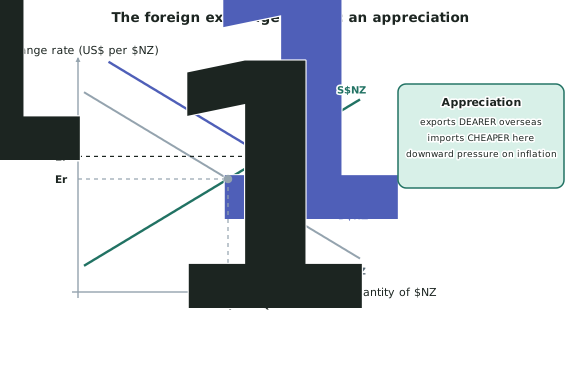
What causes an appreciation
- Higher New Zealand interest rates — the RBNZ raises the OCR, so New Zealand assets offer a better return, overseas investors buy $NZ, demand shifts right.
- Higher world prices for New Zealand exports — overseas buyers need more $NZ to pay for the same volume, demand shifts right.
- Stronger overseas demand for New Zealand goods — same effect.
- Falling New Zealand demand for imports — fewer $NZ are sold, supply shifts left.
What an appreciation does
- Exports become dearer overseas. A NZ$10 product costs a US buyer more US dollars, so they buy less. Export receipts (X) fall.
- Imports become cheaper in New Zealand. A US$100 item costs fewer NZ dollars. Import payments (M) may rise or fall depending on how much more is bought.
- AD shifts left through lower net exports, so real GDP and employment fall.
- AS shifts right slightly, because imported raw materials cost less, lowering firms' costs of production.
- Inflation falls — through both cheaper imported goods and lower production costs.
- The current account generally worsens, because export receipts fall.
What a depreciation does
Exactly the reverse, and it is the more commonly examined direction:
- Exports become cheaper overseas, so they are more price competitive and overseas buyers purchase more. Export receipts (X) rise.
- Imports become dearer in New Zealand. Import payments (M) rise for the same volume.
- AD shifts right through higher net exports, so real GDP and employment rise.
- AS shifts left, because imported fuel, raw materials and components now cost more, raising firms' costs of production.
- Inflation rises — through dearer imported goods on the shelf and through higher production costs. This is imported inflation.
- The current account generally improves, though not immediately, because volumes take time to respond.
Why it appears in the monetary policy question every year
- The OCR affects the exchange rate, and the exchange rate affects inflation. So any complete answer about monetary policy has to include it.
- The 2025 Merit bullets name it directly: candidates "explained that a depreciation would make New Zealand exports more price competitive and imports more expensive".
Worked ExampleA depreciation of the New Zealand dollar
Weak world demand for New Zealand exports causes the New Zealand dollar to depreciate against its major trading partners.
Explain, referring to the foreign exchange model and the AD/AS model, the impact on New Zealand's goals of price stability and economic growth.
Step 1 — Show the depreciation on the foreign exchange model
Weak world demand means overseas buyers are purchasing fewer New Zealand goods and services, so they need fewer New Zealand dollars to pay for them.
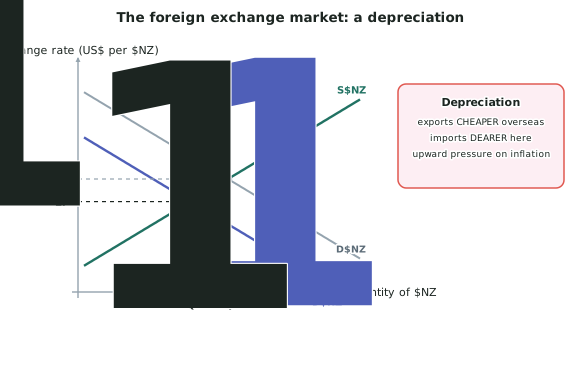
On the foreign exchange model, the demand for the $NZ shifts left, from D$NZ to D$NZ1. The supply of $NZ is unchanged.
At the new equilibrium the exchange rate falls from Er to Er1 — the New Zealand dollar has depreciated.
Step 2 — What the depreciation does to trade
Exports become cheaper overseas. A product priced at NZ$100 now costs an overseas buyer fewer units of their own currency, so New Zealand exports become more price competitive. Overseas buyers purchase more, so export receipts (X) rise — partly offsetting the original fall in demand.
Imports become dearer in New Zealand. An item priced at US$50 now costs more New Zealand dollars. New Zealanders pay more for fuel, vehicles, electronics and imported raw materials. Import payments (M) rise for the same volume, though volumes fall over time as buyers switch to New Zealand alternatives.
Step 3 — The impact on price stability
The depreciation is inflationary through two channels:
- Directly, because imported consumer goods cost more on the shelf. Fuel is the clearest example, and because fuel affects transport costs for almost everything, the effect spreads across the CPI.
- Indirectly, because imported raw materials and components cost more, raising firms' costs of production. On the AD/AS model this shifts AS left to AS1, raising the price level.
This is imported inflation — inflation caused by events outside New Zealand rather than by domestic demand.
The goal of price stability moves away from being met, and if it pushes annual CPI inflation above the RBNZ's 1–3% band, the RBNZ would need to respond by raising the OCR.
Step 4 — The impact on economic growth
Two forces work in opposite directions:
Pushing growth up. Higher export receipts and lower import volumes mean net exports (X − M) rise, so AD shifts right to AD1. Exporting firms — dairy, tourism, manufacturing — receive more revenue, expand output and hire more workers. Real GDP rises.
Pushing growth down. Higher costs of imported inputs shift AS left to AS1, which reduces real GDP and raises the price level.
Step 5 — Judge which dominates
The AD effect on real GDP is larger for New Zealand, because exports are a very large share of GDP and the export sectors respond strongly to becoming more price competitive.
But the AS effect is faster: import prices rise as soon as the exchange rate moves, whereas export volumes take months to a year to respond, as overseas buyers renegotiate contracts and switch suppliers.
So in the short run the cost effect dominates and the depreciation looks mainly inflationary. In the medium run the export volume response builds and real GDP rises, so the goal of economic growth is served.
Step 6 — Note the conflict between the goals
This is the pattern the Excellence criterion asks for: one influence, different goals, opposite directions.
The depreciation helps economic growth and the current account, and damages price stability. A government or central bank cannot welcome one without accepting the other, and the RBNZ's response — raising the OCR to protect the inflation target — would appreciate the currency again and undo the growth benefit.