Complex numbers in rectangular form
Where complex numbers come from
- Some quadratic equations have no real solution. needs a number whose square is , and no real number squares to a negative.
- Mathematicians defined one:
- is called the imaginary unit. Everything in this standard is built from it.
- A complex number is any number of the form , where and are real.
- is the real part, written .
- is the imaginary part, written .
- Note carefully: the imaginary part is , a real number — not . For , , not .
Every real number is a complex number
- The 2026 specification states it directly: complex numbers include real numbers.
- A real number such as 7 is the complex number — its imaginary part is zero.
- A number with zero real part, such as , is called purely imaginary.
- This matters because questions ask things like "find so that is purely real". That is an instruction to set the imaginary part equal to zero and solve.
Simplifying powers of
- Powers of cycle with period 4:
- Divide the exponent by 4 and use the remainder.
- : , so the remainder is 3 and .
- : remainder 0, so .
Square roots of negative numbers
- Write the negative root as a positive root times :
- , and .
- Convert to form first, then multiply. The rule fails for negatives: is , not .
Adding and subtracting
- Add real parts to real parts and imaginary parts to imaginary parts. It is collecting like terms.
- — watch the sign on the ; subtracting it adds.
Multiplying
- Expand the brackets exactly as in ordinary algebra, then replace with and collect.
- Do not memorise that formula — just expand and simplify. Worked through:
- Squaring works the same way, but you must expand the binomial properly:
- The error the assessors see is writing . There is a middle term.
Equating real and imaginary parts
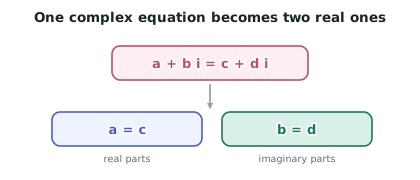
- Two complex numbers are equal only when both their real parts and their imaginary parts match.
- This turns one complex equation into two real equations, and it is the engine behind most Merit and Excellence questions on this standard.
-
To use it:
- Expand and simplify both sides into the form .
- Group every term containing together, and everything else together.
- Set the two real parts equal, and the two imaginary parts equal.
- Solve the resulting pair of simultaneous equations.
-
Worked through — find real and with :
- Expand:
- Real parts:
- Imaginary parts:
- Solving gives , .
Purely real and purely imaginary
- Purely real means — set the imaginary part to zero and solve.
- Purely imaginary means — set the real part to zero and solve.
- The 2025 report lists "demonstrated understanding of purely real or purely imaginary complex numbers, and could form the resulting equations" as a Merit behaviour, so these questions are worth the practice.
Worked ExampleFinding unknown real constants
Find the real numbers and such that .
Step 1 — Expand the left-hand side
Treat it as an ordinary binomial expansion, keeping every term:
Step 2 — Replace
The last term contains , which is :
Step 3 — Group into real and imaginary parts
Collect everything without an , then everything with an :
Writing it in this grouped form before comparing is what makes the next step safe.
Step 4 — Equate real and imaginary parts
The left side must equal . Two complex numbers are equal only when both parts match, so we get two real equations:
Step 5 — Solve the simultaneous equations
From the first equation, . Substitute into the second:
Back-substitute to find :
Step 6 — Check in the original equation