The Argand diagram, modulus and argument
Plotting a complex number
- A complex number has two independent pieces of information — a real part and an imaginary part — so it needs two axes to be drawn.
- An Argand diagram is a set of axes where:
- the horizontal axis is the real axis, carrying
- the vertical axis is the imaginary axis, carrying
- The number is plotted at the point .
- goes 3 right and 4 up. goes 2 left and 1 down.
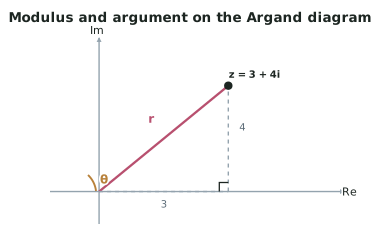
- The diagram is not decoration. The 2025 assessor report recommends sketching one whenever you need an argument, because it is what stops you putting the angle in the wrong quadrant.
The modulus
- The modulus of , written , is the distance from the origin to the point.
- By Pythagoras on the right-angled triangle in the diagram:
-
Each variable:
- — the real part, the horizontal distance
- — the imaginary part, the vertical distance
- — the length of the line from the origin, sometimes called the magnitude
-
.
-
The modulus is never negative. It is a distance. If your working produces , you have made an error or you have picked up an invalid root — reject it.
-
, which links the modulus back to the conjugate.
The argument
- The argument of , written , is the angle the line from the origin makes with the positive real axis, measured anticlockwise.
- It is found from the same right-angled triangle:
- But you cannot simply take and stop. A calculator's inverse tangent always returns an angle between and , so it can only ever land in the first or fourth quadrant. For a number in the second or third quadrant it gives the wrong answer.
Getting the quadrant right
- The reliable method:
- Sketch the point. One glance tells you which quadrant it is in.
- Find the reference angle using the positive values: .
- Adjust the reference angle to the correct quadrant.
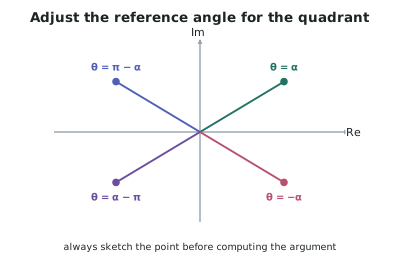
- In radians, taking as the reference angle:
- Quadrant 1 (, ):
- Quadrant 2 (, ):
- Quadrant 3 (, ):
- Quadrant 4 (, ):
The principal argument
- Every complex number has infinitely many arguments, because adding takes you a full turn and returns to the same point.
- The principal argument is the one in the range:
- Unless a question says otherwise, give the principal argument. An answer of should be written as .
- The 2025 report notes that in one question "candidates frequently missed that the argument was negative and gave the positive value instead" — that is precisely this mistake.
Working in radians
- Level 3 Calculus works in radians unless a question says degrees.
- The angles worth knowing by sight:
- , , , ,
- Check your calculator is in radian mode before you start. Getting this wrong makes every angle on the paper wrong.
Special cases
- Positive real numbers lie on the positive real axis: .
- Negative real numbers lie on the negative real axis: .
- Positive imaginary (, ) points straight up: .
- Negative imaginary points straight down: .
- has modulus 0 and no defined argument — there is no direction to point in.
The modulus of an expression
- obeys useful rules that save a lot of work:
- — the modulus of a product is the product of the moduli
- So without ever expanding the bracket.
Worked ExampleModulus and argument in the second quadrant
Find the modulus and the principal argument of , giving the argument in exact radian form.
Step 1 — Identify the parts and sketch
The real part is negative and the imaginary part is positive, so the point lies in the second quadrant — up and to the left. This is the fact that decides everything from here.
Step 2 — Find the modulus
Apply , remembering to square the coefficient and the surd:
Step 3 — Find the reference angle
The reference angle uses the magnitudes of the parts, ignoring signs:
Step 4 — Adjust for the quadrant
A calculator asked for would return , which points into the fourth quadrant — the wrong place entirely.
The point is in the second quadrant, so the argument is :
Step 5 — Check it is the principal argument
The principal range is . Since and , it is inside the range ✓
Step 6 — Sense-check against the sketch
is , which is between and — the second quadrant. It matches the picture.