Manipulating surds
Why surds are in a complex numbers standard
- A surd is a root that cannot be written exactly as a fraction — , , .
- Surds are named directly in the standard's list of methods, and they turn up in this paper for a specific reason: the quadratic formula produces them, and so does every modulus you calculate.
- An answer left as instead of , or with a surd still in the denominator, is not in simplest form and can lose the mark.
Simplifying a surd
To simplify :
-
Find the largest perfect square that divides .
-
Split the root into two: .
-
Take the square root of the perfect square outside.
-
Worked through:
-
Note the rule works for division too: .
The rule that does not exist
- is not .
- Check it once and never forget it: , but .
- Roots distribute over multiplication and division only, never over addition or subtraction.
Adding and subtracting surds
-
Surds add like algebraic terms: you can only combine like surds, ones with the same number under the root.
-
, in exactly the way .
-
cannot be simplified — the surds are unlike.
-
Always simplify first, because unlike surds often become like:
Multiplying surds
- Multiply the numbers outside, multiply the numbers inside, then simplify.
-
-
Squaring a surd removes the root: , and .
-
Expanding brackets works exactly as it does in algebra:
Rationalising the denominator
- Rationalising means rewriting a fraction so no surd is left in the denominator.
- For a single surd, multiply top and bottom by that surd:
- For a two-term denominator, multiply top and bottom by the conjugate — the same expression with the middle sign flipped.
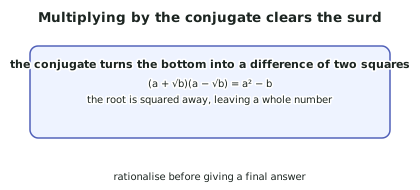
- The conjugate of is , and multiplying them gives a difference of two squares:
-
The surd disappears because it gets squared. That is the entire trick.
-
Worked through:
Why this matters for complex numbers
- The complex conjugate works by exactly the same mechanism. To divide by you multiply by , and the bottom becomes .
- If you can rationalise a surd denominator fluently, division of complex numbers is the same move with instead of .
- The 2025 assessor report names both skills — rationalising denominators, and multiplying by a conjugate fraction — as fundamental, and lists failing to multiply surds correctly among the things Not Achieved candidates did.
Worked ExampleSimplifying and rationalising
Simplify , and write with a rational denominator.
Step 1 — Simplify each surd separately
The two surds look unlike, so before deciding anything we simplify both by pulling out the largest perfect square.
Step 2 — Now subtract
Both are multiples of , so they are like surds and combine like algebraic terms.
Step 3 — Choose the conjugate
For the fraction, the denominator is . Its conjugate is — the same two terms with the middle sign flipped.
We multiply the fraction by , which is 1, so the value of the fraction does not change.
Step 4 — Multiply out the denominator
This is a difference of two squares, so the surd squares away:
Step 5 — Multiply out the numerator
Expand carefully, term by term:
Step 6 — Put it together
Check: the denominator is now a whole number, so the expression is rationalised. Numerically the original is , and ✓