Multiplying and dividing in polar form
Why polar form exists
- Multiplying two complex numbers in rectangular form takes four products and a collection step. In polar form it takes one multiplication and one addition.
The multiplication rule
- In words: multiply the moduli, add the arguments.
The division rule
- In words: divide the moduli, subtract the arguments.
What multiplication does geometrically
- Multiplying by does exactly two things to a point on the Argand diagram:
- stretches its distance from the origin by a factor of
- rotates it anticlockwise through an angle
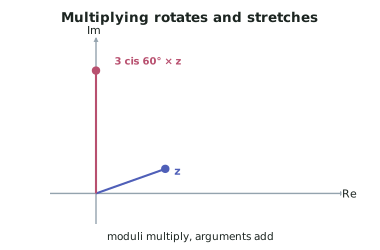
- Special cases that follow immediately:
- Multiplying by rotates a quarter turn anticlockwise and changes nothing else.
- Multiplying by rotates a half turn.
- Multiplying by a positive real number is a pure stretch, with no rotation.
Keeping the argument principal
- Adding two arguments can push the total outside .
- Add or subtract until the result is back in range.
- , and , so the answer is .
The conjugate in polar form
- Reflecting in the real axis leaves the distance unchanged and negates the angle:
- It follows that , which is the polar-form version of the identity from the conjugate page.
The reciprocal in polar form
- Setting and in the division rule:
- So the reciprocal inverts the modulus and negates the argument.
Choosing your route
-
A question like "find " can be done either way. In polar form:
- Convert each factor: , ,
- Moduli:
- Arguments:
- Answer: , or in rectangular form.
-
Note how little arithmetic that took compared with expanding three brackets and rationalising.
Worked ExampleCombining products and quotients in polar form
Given and , find and , giving each answer in polar form with a principal argument.
Step 1 — The product: handle the moduli
Multiply the moduli:
Step 2 — The product: handle the arguments
Add the arguments:
Step 3 — Check the range
is comfortably inside , so no adjustment is needed.
Step 4 — The quotient: handle the moduli
Divide the moduli:
Step 5 — The quotient: handle the arguments
Subtract the arguments. Take care with the double negative:
Step 6 — Bring the argument into the principal range
, which is greater than , so it is outside the range. Subtract :
Step 7 — Sense-check both answers
is in the second quadrant and points straight down. Rotating clockwise by a quarter turn (multiplying by 's direction) should bring it into the first quadrant — and is first-quadrant ✓
Dividing rotates anticlockwise by a quarter turn instead, taking it from the second quadrant into the third — and is third-quadrant ✓