Polar form and converting between forms
The second way to describe a complex number
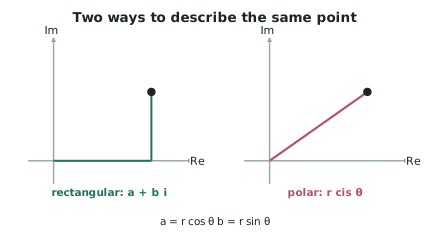
- Rectangular form locates a point by how far right and how far up.
- Polar form locates the same point by how far from the origin and in what direction.
- Both describe exactly the same number. Which one you use is a matter of which operation you are about to do.
Building polar form from the triangle
- From the right-angled triangle on the Argand diagram, with and :
- Substituting into :
- NZQA abbreviates to , so:
- Each variable:
- — the modulus, ; always positive
- — the argument, the anticlockwise angle from the positive real axis
- "cis" — short for cosine i sine; it is notation, not a function you can split up
Converting rectangular to polar
-
Find the modulus: .
-
Sketch the point to identify the quadrant.
-
Find the reference angle and adjust for the quadrant.
-
Write the answer as .
-
Worked through for :
- First quadrant, , so
Converting polar to rectangular
- Evaluate and , then multiply each by .
-
Worked through for :
- and
-
Note that this direction is much easier than the other — there is no quadrant decision to make, because the angle already tells you where the point is.
The exact values worth knowing
- These come up constantly, and knowing them lets you give exact answers rather than decimals:
Equal complex numbers in polar form
- Two numbers in polar form are equal when their moduli are equal and their arguments differ by a whole number of full turns:
- That is not a technicality. It is exactly what generates multiple roots when you solve , which is covered later in this standard.
Fixing an "illegal" polar form
-
A polar form is only standard when is positive. Two situations need fixing:
- Negative modulus: . Multiplying by rotates the point half a turn.
- Argument out of range: add or subtract until lies in .
-
So becomes , and then, bringing the argument into the principal range, .
Choosing which form to work in
- Rectangular for: adding, subtracting, equating real and imaginary parts, checking whether something is purely real or imaginary.
- Polar for: multiplying, dividing, powers, roots, and anything involving rotation.
- Many questions are a conversion sandwich: convert to polar, do the multiplication or the power, convert back to rectangular because that is the form the answer was requested in.
Worked ExampleConverting both ways
(a) Write in polar form with an exact argument. (b) Write in the form .
Part (a), Step 1 — Sketch and identify the quadrant
(negative, so left) and (positive, so up), which places in the second quadrant.
Part (a), Step 2 — Find the modulus
Part (a), Step 3 — Find the reference angle
Using magnitudes only:
Part (a), Step 4 — Adjust for the second quadrant
In quadrant 2, :
This is inside , so it is the principal argument.
Part (b), Step 1 — Split the cis
Part (b), Step 2 — Evaluate the trig exactly
Cosine is an even function, so the negative angle makes no difference to it. Sine is odd, so it picks up the minus sign:
Part (b), Step 3 — Multiply each by
Part (b), Step 4 — Sense-check
The argument is negative and small, so the point should be in the fourth quadrant — right and down. The answer has positive real part and negative imaginary part ✓ And , matching the modulus we started with ✓