Roots of complex numbers
The equation to solve
- The standard names equations of the form:
where , are real and is a positive integer.
- The central fact: an equation has exactly solutions, no more and no fewer.
- has three solutions, not one. Only one of them is the real number 2.
Where the extra roots come from
- A complex number does not have one argument; it has infinitely many, all differing by .
- So is equally well written as for any integer .
- Taking the th root divides that argument by :
- Dividing by means the jumps become jumps — small enough that different answers fit inside one full turn before they start repeating.
- Note why stops at : putting adds a whole to the argument and returns you to the root.
What the roots look like
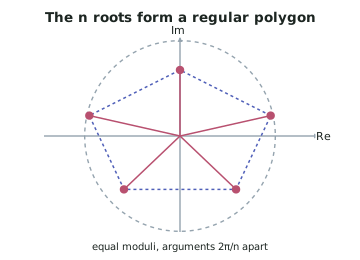
-
The roots always:
- lie on a circle of radius centred on the origin — every root has the same modulus
- are spaced equally around that circle, apart
- form the vertices of a regular -sided polygon
-
These three facts are a free check on your answer, and they are also a fast way to find the remaining roots once you have one: just keep adding to the argument.
The procedure
-
Convert the right-hand side to polar form. Sketch it, because a wrong argument here ruins everything.
-
Take the th root of the modulus: .
-
Write the general argument as .
-
Substitute in turn.
-
Reduce each argument into .
-
Convert to rectangular form if the question asks for it.
-
Worked through for :
- Modulus of each root:
- Arguments: for , giving , ,
- Reduce the last:
- Roots: , ,
- Note the second and third are a conjugate pair, exactly as they must be for a real-coefficient equation.
Choosing values of that land in range
- Using always works, but the last few arguments then need reducing.
- A neater alternative is to choose symmetrically about zero — for , take . Every argument then comes out principal already.
- Either approach is acceptable; pick one and be consistent.
Roots of unity
- The solutions of are the th roots of unity.
- They lie on the unit circle, at arguments , and always include itself.
- Their sum is zero for , because the vertices of a regular polygon centred on the origin cancel out.
Worked ExampleSolving a fourth-power equation
Solve , giving all solutions in polar form with principal arguments.
Step 1 — Convert the right-hand side to polar form
(negative) and (positive), so the point is in the second quadrant.
Modulus:
Reference angle:
Second quadrant, so :
Step 2 — Find the modulus of each root
Take the fourth root of 16:
All four roots have modulus 2 — they sit on a circle of radius 2.
Step 3 — Write the general argument
Divide the general argument of the right-hand side by 4:
The gap between consecutive roots is , which is as expected.
Step 4 — Substitute four values of
Choosing keeps every argument principal without any later reduction:
- :
- :
- :
- :
Step 5 — Write the four solutions
Step 6 — Check
Same modulus? All four are 2 ✓ Equal spacing? From to is ; from to is ; from to is ✓ Right number? Four roots for a fourth-power equation ✓ Spot check: , which is the right-hand side ✓