The complex conjugate and division
What the conjugate is
- The complex conjugate of is written (or sometimes ) and is formed by flipping the sign of the imaginary part:
- , , .
- The real part is left alone. Only the sign in front of changes.
- A real number is its own conjugate, because there is no imaginary part to flip.
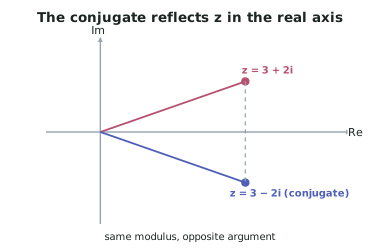
- Geometrically, taking the conjugate reflects the point in the real axis. That picture explains every property below.
The property that makes conjugates useful
- Multiplying a complex number by its own conjugate always gives a real number:
- is a sum of squares, so it is always real and never negative.
- This is the difference of two squares doing the same job it does when rationalising surds — except that here turns the minus into a plus.
- .
Other conjugate properties
- Adding a number to its conjugate leaves twice the real part:
- Subtracting leaves twice the imaginary part, times :
-
The conjugate passes through sums and products unchanged:
-
The consequence that matters for polynomials: if a polynomial has real coefficients and is a root, then is also a root. Complex roots of real polynomials always come in conjugate pairs.
Dividing complex numbers
- You cannot leave in a denominator, for the same reason you cannot leave a surd there.
- Multiply the top and bottom by the conjugate of the denominator.
-
The denominator becomes the real number , and then you simply divide each part.
-
The procedure, step by step:
- Write the conjugate of the denominator — not the numerator.
- Multiply both top and bottom by it.
- Expand the numerator, replacing with .
- Compute the denominator as directly; there is no need to expand it in full.
- Split into the form by dividing each part.
-
Worked through:
Simplifying a fraction with alone underneath
- If the denominator is just , multiplying by the conjugate still works, but there is a shortcut: multiply top and bottom by .
- Equivalently, dividing by is the same as multiplying by , because .
Finding the reciprocal
- The reciprocal is a division like any other:
- So .
Worked ExampleDivision and the conjugate-pair property
Given , express in the form . Then show that is real.
Step 1 — Identify the conjugate of the denominator
The denominator is . Flipping the sign of the imaginary part gives the conjugate .
Step 2 — Multiply top and bottom by it
Multiplying by is multiplying by 1, so the value of is unchanged:
Step 3 — Work out the denominator
Use directly rather than expanding:
Step 4 — Expand the numerator
Every term, then replace :
Step 5 — Divide each part
Split the fraction so the real and imaginary parts are visible:
Step 6 — Now form the conjugate
Flip the sign of the imaginary part:
Step 7 — Add them
The imaginary parts are equal and opposite, so they cancel exactly:
This is real, as required.