Quadratic equations and the discriminant
The quadratic formula still works
- For with :
- Each variable:
- — the coefficient of
- — the coefficient of
- — the constant term
- At Level 3 the formula is used even when the square root is negative, because is now a legal object.
The discriminant
- The discriminant is the expression under the root:
-
It decides the nature of the roots without solving anything:
- — two distinct real roots
- — one repeated real root (a "double root")
- — two distinct complex roots, which are conjugates of each other
-
Note the phrase used in exam questions: "real and distinct" means ; "equal roots" or "a repeated root" means ; "no real roots" means .
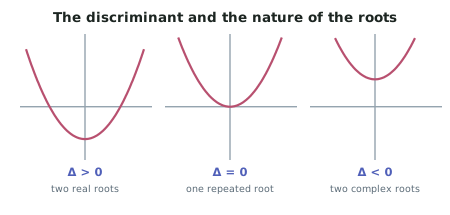
- Graphically: counts how many times the parabola crosses the -axis. When it crosses nowhere, the roots are complex.
Solving when the discriminant is negative
-
Apply the quadratic formula as usual.
-
Rewrite the negative root using .
-
Simplify the surd, then split the fraction into form.
-
Worked through for :
- , so the roots are complex
-
The two roots and are conjugates, as they must be for a quadratic with real coefficients.
Completing the square
-
The alternative method, and the one to use when the coefficients contain unknown constants that stop a calculator helping.
-
For :
- Halve the coefficient of and square it.
- Add and subtract that value to build a perfect square.
- Rearrange and take the square root of both sides — remembering both signs.
-
Worked through for :
Building a quadratic from its roots
- If a quadratic has roots and , then:
-
Sum of roots , product of roots .
-
Given a complex root of a real-coefficient quadratic, you get the other one free — it is the conjugate — and then:
- Sum , which is real
- Product , which is real
-
So the quadratic always comes out with real coefficients, as it must.
-
Worked through: a quadratic with root and real coefficients.
- Other root:
- Sum: 6. Product: .
- Equation:
Questions with an unknown constant
- The 2026 specification states that candidates must handle "the manipulation of constants, e.g. solving an equation to find an expression for in terms of ".
- These questions typically read: "find the values of for which has complex roots".
- Form the discriminant:
- Apply the condition: complex roots means , so
- Solve the inequality: , so
- Note that the answer is a range, not a single value, because the condition was an inequality.
Worked ExampleComplex roots and reconstructing the equation
(a) Solve , giving the roots in the form . (b) Find the values of for which has two distinct complex roots.
Part (a), Step 1 — Identify the coefficients and test the discriminant
is negative, so we expect two complex conjugate roots.
Part (a), Step 2 — Apply the quadratic formula
Part (a), Step 3 — Convert and simplify the surd
Write the negative root in terms of , then simplify:
Part (a), Step 4 — Divide through and split into
Every term in the numerator has a factor of 2, so cancel it against the 4:
Part (b), Step 1 — Write the discriminant in terms of
Here , and :
Part (b), Step 2 — Apply the condition
"Two distinct complex roots" means the discriminant is strictly negative:
Part (b), Step 3 — Solve the inequality
A square is less than 16 exactly when the quantity being squared lies between and :
Add 1 throughout:
Part (b), Step 4 — Check with a test value
Take , which is inside the range. The equation becomes , with ✓ complex roots.
Take , outside the range: , with ✓ real roots, as predicted.