Comparing two percentages and making the call
Why you cannot just compare the two intervals
- A report gives two percentages and claims one is bigger. To judge that claim you need the margin of error for the difference, not for either percentage on its own.
- The difference of two estimates carries both uncertainties, so its margin of error is larger than either individual margin of error.
- Which rule you use depends on where the two percentages came from, and getting this right is one of the most reliable sources of marks in the standard.
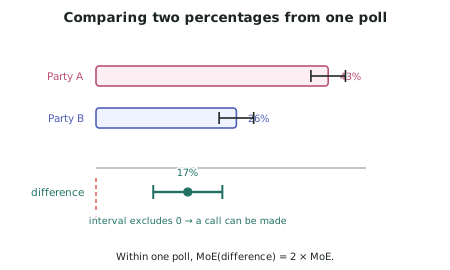
Case 1 — two percentages from the same group
- This is comparing two response categories within one survey: Party A against Party B in the same poll, or "agree" against "disagree" among the same respondents.
- The two percentages are linked: they are shares of the same total, so if one rises the other must fall. That connection makes the difference more variable, not less.
- Rule:
- Where for the single poll.
Case 2 — the same percentage in two independent groups
- This is comparing one category across two separate samples: this month's poll against last month's, men against women (as two separate subgroups), Auckland against Canterbury.
- The two estimates come from different people, so the estimates are independent.
- Rule:
- If the two groups are the same size, this simplifies to .
- Note that subgroups have their own sample sizes. If a poll of 1 000 reports separately on 400 men and 600 women, use and — not 1 000.
Making the call
- Once you have the margin of error for the difference, the decision rule is one line:
If the observed difference is bigger than the margin of error for the difference, you can call it. If not, you cannot.
-
Write the conclusion in three parts, in context:
- the observed difference
- the margin of error for the difference
- the call, naming the population.
-
Both possible conclusions have correct wording:
- Difference exceeds the margin of error: "It is likely that a higher proportion of Auckland residents than Canterbury residents support the proposal."
- Difference does not exceed it: "We cannot tell which group has the higher proportion — the difference could be due to sampling variability alone."
-
Never say "there is no difference." Failing to detect a difference is not evidence that none exists; it means the survey was not precise enough to settle the question.
Subgroups are less precise than the headline
- Reports constantly headline a subgroup finding — "young people are far more likely to…" — using the whole survey's margin of error.
- If the subgroup has , its margin of error is , not the 3.2% quoted for the full sample of 1 000.
- Spotting this is one of the highest-value criticisms available: the smaller the group a report is excited about, the less reliable its number.
Worked ExampleTwo comparisons, two different rules
A national poll surveys 1 000 eligible voters.
- Party A: 38% Party B: 31%
- The sample includes 420 people aged under 40 and 580 aged 40 and over. Among the under-40s, 44% said they would use public transport more if fares were halved; among the over-40s, 33% said the same.
(a) The report claims "Party A is ahead of Party B." Can this call be made? (b) The report claims "Under-40s are more likely than over-40s to respond to a fare cut." Can this call be made?
(a) Two parties within the same poll
Step 1 — Identify the case. Both percentages come from the same 1 000 respondents, as two categories of the same question. This is a within-group comparison, so the multiplier is 2.
Step 2 — Find the margin of error for one percentage.
Step 3 — Apply the within-group rule.
Step 4 — Find the observed difference.
Step 5 — Compare and make the call.
(b) Two independent age groups
Step 1 — Identify the case. The under-40s and the over-40s are different people, so these are two independent groups. The multiplier is 1.5 times the average of the two margins of error.
Step 2 — Find each group's own margin of error. Use each subgroup's own sample size, not 1 000.
Step 3 — Apply the independent-groups rule.
Step 4 — Find the observed difference.
Step 5 — Compare and make the call.