Wave properties and the wave equation
Key ideas
A wave transfers energy from place to place without transferring matter — the medium vibrates but does not travel with the wave.
Every wave is described by the same set of quantities:
| Symbol | Quantity | Meaning | Unit |
|---|---|---|---|
| wavelength | length of one full cycle | m | |
| frequency | cycles passing a point each second | Hz | |
| period | time for one full cycle | s | |
| speed | how fast the wave travels | m s⁻¹ | |
| amplitude | maximum displacement from rest | m |
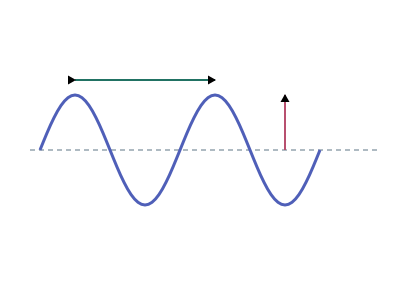
Transverse vs longitudinal waves
- Transverse — the medium vibrates at right angles to the direction the wave travels.
- Example: light, water surface waves, a wave on a rope.
- Longitudinal — the medium vibrates back and forth along the direction of travel, making compressions and rarefactions.
- Example: sound in air.
The wave equation
The speed of a wave is its wavelength times its frequency:
- — wave speed (m s⁻¹)
- — frequency (Hz)
- — wavelength (m)
Frequency and period are reciprocals:
And for a wave (or pulse) crossing a known distance in a known time:
:::tip When a wave crosses into a new material its frequency never changes — the source sets it. What changes is the speed, and therefore the wavelength ( with fixed). If your working keeps the same across a boundary, you are on the right track. :::
A wave has a frequency of Hz and a wavelength of m. Find its speed and period.
Step 1 — Speed, from the wave equation
Step 2 — Period, the reciprocal of frequency
Practice question
A water wave travels m in s and has a wavelength of m. Find its frequency.
Worked solution: speed first, m s⁻¹. Then Hz.
Test yourself
Practice by grade
One question each at Achieved, Merit and Excellence. Have a go, then compare with the model answer.
A sound wave has a frequency of Hz and travels at m s⁻¹.
Calculate its wavelength.
A wave on a rope has a period of s and a wavelength of m.
Calculate the speed of the wave, showing each step.
A wave passes from a region where it travels at m s⁻¹ into a region where it slows to m s⁻¹.
Explain fully what happens to its frequency and wavelength, with a supporting calculation if its original wavelength was m.