Reflection and refraction at a plane boundary
Key ideas
When a wave meets a boundary between two media, part of it can reflect back and part can transmit into the new medium, where it may refract (change direction).
Across the boundary, one quantity is always conserved and two can change:
- Frequency — always unchanged (set by the source).
- Speed — changes if the new medium is different.
- Wavelength — changes in step with the speed, because with fixed.
Reflection at a boundary
- The wave bounces back into the original medium.
- Speed, frequency and wavelength are all unchanged — it is the same medium.
- Phase change on reflection: a wave reflecting off a denser/fixed boundary is inverted (a crest returns as a trough — a phase change). Reflecting off a less dense/free boundary, it is not inverted.
Refraction at a boundary
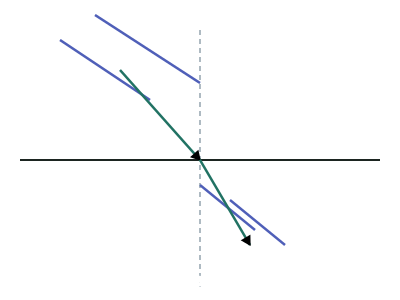
- Refraction is the bending of a wave as it crosses into a medium where it travels at a different speed.
- Slowing down bends the wave toward the normal; speeding up bends it away from the normal.
- The frequency is unchanged, so:
- , — speed and wavelength in the first medium
- , — speed and wavelength in the second medium
:::tip Think of a marching band walking from firm ground onto mud at an angle. Whichever end of the row hits the mud first slows first, so the whole row swings around toward the normal. This is exactly why the wavefronts bend — and it never changes the frequency (the marchers keep the same step rate). :::
A water wave travelling at m s⁻¹ with a wavelength of m crosses into shallower water where it slows to m s⁻¹. Find the new wavelength.
Step 1 — Frequency is unchanged, so find it
Step 2 — Use the same frequency in the new medium
Practice question
A wave slows from m s⁻¹ to m s⁻¹ crossing a boundary. Its original wavelength was m. Find the new wavelength.
Worked solution: Hz (unchanged), so m.
Test yourself
Practice by grade
One question each at Achieved, Merit and Excellence. Have a go, then compare with the model answer.
A wave refracts as it enters a new medium. State what happens to its frequency, and state whether it bends toward or away from the normal if it speeds up.
A wave travels at m s⁻¹ with wavelength m. It crosses into a medium where its speed becomes m s⁻¹.
Calculate the new wavelength.
Straight wavefronts in deep water meet the boundary with a region of shallow water at an angle. Explain fully why the wave changes direction, referring to wave speed and to what happens to the wavefronts.