Refraction through lenses
Key ideas
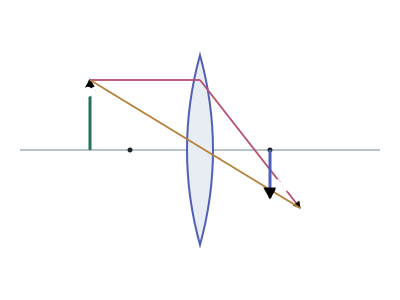
A converging (convex) lens refracts parallel rays so they meet at the focal point, a distance (the focal length) from the lens. Lenses form images whose position and size are found with two relationships.
The lens equation
- — focal length of the lens (m)
- — object distance (lens to object, m)
- — image distance (lens to image, m)
A positive means a real image (on the far side, can be projected onto a screen). A negative means a virtual image (same side as the object, seen by looking through the lens — e.g. a magnifying glass).
Magnification
- — image height, — object height
- → image enlarged; → image reduced
- A real image from a single converging lens is inverted; a virtual image is upright.
:::tip Take reciprocals last. Students often compute correctly then forget to flip it, quoting the reciprocal as the answer. After , the image distance is cm — not cm. :::
An object is placed cm from a converging lens of focal length cm. Find the image distance and the magnification.
Step 1 — Rearrange the lens equation for
Step 2 — Combine the fractions
Step 3 — Take the reciprocal for the image distance
Step 4 — Magnification
Practice question
An object sits cm from a converging lens of focal length cm. Find the image distance.
Worked solution: , so cm.
Test yourself
Practice by grade
One question each at Achieved, Merit and Excellence. Have a go, then compare with the model answer.
An object is cm from a converging lens of focal length cm.
Calculate the image distance.
A cm tall object is placed cm from a converging lens of focal length cm.
Calculate the image distance and the height of the image.
An object is placed closer to a converging lens than its focal length (). Using the lens equation, explain fully why the image formed is virtual, upright and enlarged — the way a magnifying glass works.