Refraction of light and Snell's law
Key ideas
Light refracts (bends) when it passes between materials because it travels at different speeds in each. Every material has a refractive index — a number that says how much it slows light down (bigger = slower light = more bending).
All angles are measured from the normal — the line at right angles to the surface.
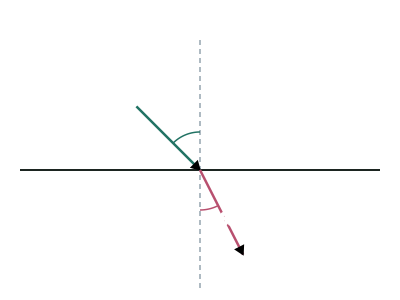
Snell's law
The relationship between the angles and refractive indices is Snell's law:
- — refractive index of the first material
- — angle of incidence (in material 1, from the normal)
- — refractive index of the second material
- — angle of refraction (in material 2, from the normal)
Speed, wavelength and refractive index
The refractive index also links the speeds and wavelengths in the two materials:
- A higher refractive index means lower speed and shorter wavelength.
- Frequency is unchanged (as always across a boundary).
:::tip Watch which way the ray bends. Going into a denser material (larger ) light slows and bends toward the normal, so . If your calculation gives a bigger angle in the denser material, you have swapped and — check the subscripts. :::
Light travels from air () into glass (), striking the surface at to the normal. Find the angle of refraction in the glass.
Step 1 — Write Snell's law and substitute
Step 2 — Solve for
Step 3 — Take the inverse sine
Practice question
Light passes from water () into air () at an angle of to the normal in the water. Find the angle in the air.
Worked solution: , so , giving (bends away from the normal, into the less dense air).
Test yourself
Practice by grade
One question each at Achieved, Merit and Excellence. Have a go, then compare with the model answer.
Light passes from air () into a plastic of refractive index at an angle of incidence of .
Calculate the angle of refraction.
Light of wavelength nm in air () enters glass of refractive index .
Calculate the wavelength of the light inside the glass.
A ray of light enters a glass block, travels through it, and exits the far parallel side back into air. Explain fully, using Snell's law, why the ray leaves parallel to the direction it entered, and why it is shifted sideways.